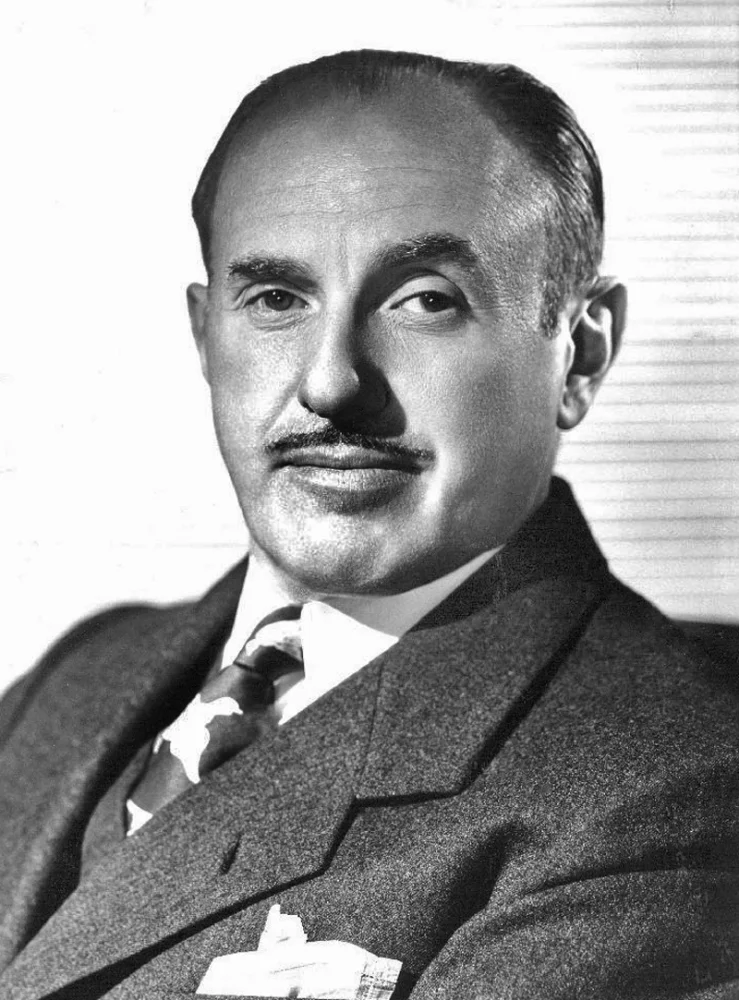
Jack Warner
- From Ontario to the movies
- “The Jazz Singer” and studio success
- Politics and later career
- A Hollywood power broker
Jack Warner helped turn a family film business into one of Hollywood’s most influential studios. As Warner Bros.’ longtime production chief and later president, he backed the move into synchronized sound that made “The Jazz Singer” a landmark, and he oversaw a steady stream of popular and acclaimed films. His career also reflected the studio system’s tough labor politics and the compromises of the Red Scare era.
From Ontario to the movies
Born Jacob Warner on 2 August 1892 in London, Ontario, he was the youngest son of Polish-Jewish immigrants Benjamin and Pearl Warner. The family later settled in Ohio, where his father worked in small businesses. Jack joined his older brothers Harry, Albert, and Sam in their early ventures in film exhibition and distribution. The brothers bought films and showed them in rented halls and small theaters, learning the business from the ground up.
The family moved into film production in the 1910s. Jack was sent to California to help establish the company’s operations there, and Warner Bros. became a studio in 1918. Harry managed much of the company’s business and served as its president, while Jack took charge of production. The brothers built a studio that was more willing than some competitors to experiment with new technology and to seek out stories about modern urban life.
“The Jazz Singer” and studio success
Warner Bros. invested in Vitaphone, a sound-on-disc system that synchronized recorded sound with film. The studio released “Don Juan” with synchronized music effects in 1926 and followed it with “The Jazz Singer” in 1927. Starring Al Jolson, the film included spoken dialogue and songs, helping persuade audiences and rival studios that sound could transform commercial cinema. Sam Warner, who had championed the technology, died shortly before its premiere. Jack became a dominant figure in the company’s production leadership.
Under his watch, Warner Bros. developed a reputation for energetic, socially engaged films and fast production. The studio released crime dramas such as “Little Caesar” and “The Public Enemy,” musicals including “42nd Street,” and prestige productions such as “The Life of Emile Zola.” Over subsequent decades, its celebrated slate included “The Adventures of Robin Hood,” “Casablanca,” “Mildred Pierce,” “A Streetcar Named Desire,” and “Rebel Without a Cause.” Warner was known for moving quickly, controlling costs, and pursuing commercially strong material.
His leadership could be combative. He clashed with talent and executives, and his public behavior sometimes irritated the people who worked with him. One widely remembered episode came at the 1943 Academy Awards, when he accepted the Best Picture Oscar for “Casablanca” before producer Hal Wallis could reach the stage. The incident contributed to Wallis’s departure from the studio.
Politics and later career
Warner was a staunch Republican, but he also supported some films that aligned with Franklin D. Roosevelt’s policies during the Depression and wartime years. In the late 1940s, he joined other Hollywood leaders in opposing communist influence in the film industry. He appeared before the House Un-American Activities Committee and named people he believed had Communist ties, a choice that damaged relationships across Hollywood and remains a controversial part of his legacy.
Warner stayed at the center of the studio for decades, serving as production chief, president, and chairman. In 1966, he retired from his executive post, and the following year he sold his controlling interest in Warner Bros. to Seven Arts. He continued to produce films independently, including the lavish 1964 screen adaptation of “My Fair Lady,” a major success that won the Academy Award for Best Picture.
A Hollywood power broker
Jack Warner died in Los Angeles on 9 September 1978, aged eighty-six. His influence can be seen in the films he helped bring to audiences and in the studio system that made Warner Bros. a durable Hollywood force. His story combines technological foresight and commercial instinct with a hard-edged approach to power. The result was a lasting legacy: a film executive who helped usher in the sound era and shaped popular cinema across several generations.