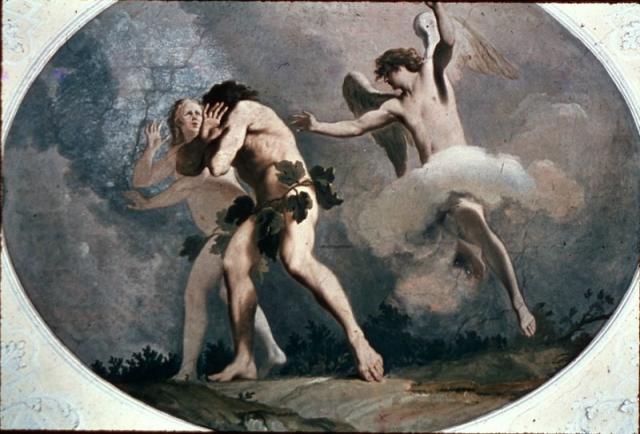
Jacopo Amigoni
 Italy
Italy- Jacopo Amigoni
- Career in Germany and Austria
- Success in England
- Later Career and Influence
- Portraits and Conversations
- Friendship with Farinelli
- Amigoni as a Versatile Artist
- Later Works and Artistic Legacy
Jacopo Amigoni
Early Life and TrainingThe birth of Italian painter, draftsman, and engraver Jacopo Amigoni remains a subject of debate. His first biographer, A. Longhi, claimed he was Venetian in his "Compendio" (1762). However, in 1935, Italian scholar J. Fioccki discovered records stating that Amigoni was Neapolitan when he received the title of Knight and the Order of Calatrava in 1750. Amigoni studied under A. Balestra in Venice and later under A. Bellucci in Treviso, possibly assisting him between 1705 and 1711 in works for Bensberg Castle in Düsseldorf.
Career in Germany and Austria
Bellucci's influence is evident in Amigoni's early paintings, such as "Moses Receiving the Crown" and "Moses with Pharaoh's Daughter." In Düsseldorf, Amigoni was likely exposed to the works of G. A. Pellegrini. After a sojourn in Rome, he adopted techniques from the painting styles of F. Solimena and Luca Giordano. Before departing for Munich in 1717, he is believed to have worked at the court of Joseph I in Vienna. During his time at the Bavarian court from 1717 to 1729, Amigoni executed numerous murals and easel paintings, including the decorations of Schleißheim Palace (1725-1728), Nymphenburg Palace (1717-1723) in Munich, Ottenbeuren Abbey (1719), Lichtenberg Castle, and the Preysing Palace in Munich (now lost).
Success in England
From 1729 to 1739, Amigoni resided in England, where he gained significant success. He visited Paris in 1736 and returned to Venice in 1739. After stints in Naples and Rome, he served the Bourbon court in Madrid from 1747 to 1752, alongside his time in Venice. In Madrid, he was awarded the title of "First Painter to the King" by Ferdinand VI. His family was granted a special pension and the privilege of accessing the royal apartments.
Later Career and Influence
Amigoni spent his final years primarily in Venice, creating altarpieces for churches in Prato, Este, and Venice. His late work is not well-documented. Amigoni's early altarpiece for the Venetian church of San Stae, depicting "St. Andrew and St. Catherine," exhibits an expressive Baroque composition with influences from Antonio Balestra and a light, joyful color scheme inspired by G. A. Pellegrini. His works for Bavarian palaces and villas, such as the four overdoors for Nymphenburg Palace featuring putti representing the elements of fire, water, air, and earth, and canvases like "Diana and Callisto" and "Bacchus and Ariadne," embody the Arcadian style practiced by Venetian "virtuosi."
Portraits and Conversations
During his stay in England, Amigoni began painting portraits against landscape backgrounds, becoming one of the first Italian artists (alongside S. and M. Ricci) to do so. He also created small pictures depicting families in domestic settings or in parks, in the manner of English painters. These works became known as "conversation pieces" ("conversazioni" in Italy).
Friendship with Farinelli
Amigoni traveled to England with his friend, the renowned Italian opera singer Carlo Broschi (1705-1782), known as "Farinelli." A Neapolitan by birth, Farinelli possessed a beautiful soprano voice and was married to the comic actress Maria Antonia Marchesini. Amigoni painted several portraits of the singer, including those in the National Gallery of Victoria, Melbourne, Bucharest's Museum of Fine Arts, the Staatsgalerie Stuttgart, the Nationalmuseum Stockholm, and the Museo di Roma.
Amigoni as a Versatile Artist
Amigoni's paintings on mythological subjects were often related to stage performances. "Death of Leander," "Perseus Freeing Andromeda," and "Juno and Mercury" may depict scenes from ballet pantomimes staged in the "Lincoln's Inn Fields" theater. He also painted "The Debutante," a canvas likely portraying a young actress standing with a fan at a table. Its light color scheme resembles the palette of Rococo painters.
Later Works and Artistic Legacy
Upon returning from England, Amigoni created "The Magnanimity of Scipio" (1739) for the Turin court, and the portrait "Family of Ferdinand IV" (National Museum and Capodimonte Gallery, Naples) for the Monte Cassino Abbey, following the conventions of "conversation pieces." Amigoni exhibited less interest in portraying the sitters' character, as seen in the "Portrait of the Infanta Maria Teresa" (Prado, Madrid) and "Queen Maria Carolina" (National Portrait Gallery, London). His works are known for their vibrant colors and elegant compositions, characteristic of Venetian Settecento painting.
Jacopo Amigoni was one of the last major "virtuoso painters" of Venice. His work gained widespread recognition across Europe, thanks to engravings by himself and talented engravers such as J. Wagner, G. Bartolozzi, G. Volpato, and C. Flipart.




