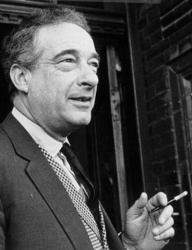
Jacques Brel
 France
Biography of Jacques Brel
Jacques Brel, the greatest of French singers and artists, never completed school. He was drawn to adventure, and for him, that adventure could only be found in songs. That was his kind of escape. He made himself by breaking free from his father's cardboard factory in the suburbs of Brussels and became not a troubadour, but rather a "Bremen musician." He traveled to Catholic establishments with the "Franch Corde" troupe, singing and entertaining the poor and the destitute. He worked relentlessly, ensuring that every word he sang sounded like his last. In the beginning, he was serious and grandiose to the point where he was nicknamed "Abbot Brel."
Over time, the nickname faded away, but his poetic work with words became even more refined and intricate. It seemed that he chose the French language not just because of its larger audience reach, but also because it was difficult to find another language that allowed for the construction of multiple different songs with just one rhyme. Although the few songs he sang in Flemish were impressive in terms of linguistic mastery and expressiveness. Fortunately, he was advised that composing music using a few well-known guitar chords was a waste of his talent. Brel was lucky to have friends and colleagues like Georges Pasquier (Jojo), who introduced him to France, Jacques Canetti, who taught him about music, and Francois Rauber. However, imitators were less fortunate.
When people talk about his work ethic, they often mention that he could give up to 300 concerts in a year without slowing down. This was comparable to the decadent rockers of the following generation. Yet, it seemed that there was no superficial glitz attached to his life, unlike what became the norm in the 1970s show business. Brel was too expansive; he wanted the infinite. He wanted to experience and feel everything. That's why he instructed his manager to never turn down any contracts (it took him six years to fulfill them all after he decided to leave the stage). This is why he pursued acting in movies and performed on stage.
He had a thirst for life, which Edith Piaf understood best: "He pushes himself to the limit because his songs express what he lives for, and every line hits you in the face so hard that it takes a long time to recover."
He was interested in "conquering the elements." The air - as a pilot, the sea - aboard a yacht, and humanity - from the stage of the Olympia. And he fought with sound in the same way: living in the studio, perfecting every note and every line with his musicians until all the elements fell into their only possible places. It took only two takes to record an entire album after that.
By that time, existentialists and beatniks had already faded into history, and the rebellious rockers were yet to emerge. Society needed a symbolic figure, and Jacques Brel became that figure for Europe, elusive and indefinable to this day. He was an artist. A poet who sang for the people. He combined natural charm with a touch of mystery, a tragic view of the world that resonates with us, and a truly romantic otherworldliness.
"Antibourgeois pathos"? It seems that it didn't exist at all. Because the most effective means of undermining any established order is not fighting for a righteous cause or the mindless rebellion of the permissive 1968, but rather mockery and ridicule.
People loved him. It was for them that he crafted chains of poetic lyrics made of simple and seemingly banal words. The audience understood that only someone whose heart was bursting with love could sing about "the veils of light" or "flaming volcanoes" in such different ways. And his sound was as passionate as what was hidden between the lines.
Sometimes Brel the poet seems too rational - it seems impossible to achieve such natural breath of passion without careful calculation of internal harmonies and rhymes. But that's how it seems until you hear him rush towards the audience in "Amsterdam," his voice trembling in the last fading notes of "Ne me quitte pas."
He, a child of the city, was adored in big cities. He filled the best concert halls - the Olympia in Paris, the Royal Albert Hall in London, Carnegie Hall in New York. And his last concert took place in a small village club. At the end of the evening, he said to the audience standing before him, "Thank you. This justifies fifteen years of love."
He didn't publicize his lung cancer - he went to the Marquesas Islands to live out his remaining time in peace with his loved ones. When his last album was released, a year before his death, after several years of public silence, people queued for hours, writing the album number on their palms. Music store owners, who had already pre-sold their entire million copies, displayed ominous posters in their windows: "Brel is no more." But Brel still was.
He passed away on October 9, 1978. His grave is in the Cimetière de Hiva-Oa, just a few steps away from Paul Gauguin.
Approximately once a year, I try to understand again and again how the words in his songs are woven together, to decipher his magic and rewrite his lines in my own language. I have his records: the naive semi-acoustic "Le Grand Jacques," the nervous "Les Marquises," the audacious "Les Flamandes," the passionate concerts at the Olympia, the farewell recording "Ne me quitte pas" - elaborate arrangements by sound masters, a mature voice. Not a single unnecessary note. Songs filled with genuine emotion. Alive. Song from the movie "The Idiot in Paris" (1967):
There are hearts, so spacious,
That when you enter them, you don't knock.
There are hearts, so spacious,
That you can't see the ceiling.
But others, too fragile,
A fist can put them to sleep.
There are hearts, too fragile,
To live like you and me.
In their eyes, there are flowers,
And fear blossoms within them.
The fear of being late even once
And missing out on Paris.
There are hearts tenderer than the sky,
Where little birds can sleep softly.
There are hearts tenderer than the sky,
Fit only for angels.
There are hearts so vast,
That they wander forever.
There are hearts so vast,
That mirages vanish within them.
In their eyes, there are no flowers.
And fear blossoms within them.
The fear of being late even once
And not making it to Paris.
There are hearts so open,
That offering them is not easy.
Hearts so open,
That they are given away entirely.
Hearts that bleed,
Hearts that are too vast.
The autumn forest curses them,
As it cannot hear their pain.
And there are no flowers in their eyes.
And fear blossoms within them.
The fear of being late even once,
And not getting to Paris.