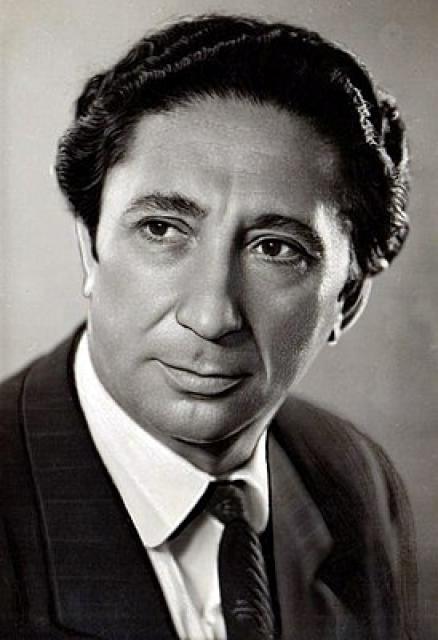
Jalal Garyaghdi
 Azerbaijan
- Early Life and Education
- Formal Training
- Artistic Journey
- Teaching and Recognition
- Significant Commissions
- Later Works
- Legacy
Early Life and Education
Jalal Karyagdy, an Azerbaijani monumental sculptor and national artist, was born on June 2, 1914, in Shusha. His passion for drawing and sculpting began in his school years. After completing secondary school, he was sent to the Azerbaijan Art College in Baku.
The college's teaching staff comprised Russian realist artists such as Gerasimov, Pritachok, and Koshichkin. Koshichkin played a pivotal role in fostering Karyagdy's love for nature and drawing. While at the college, he attended the workshops of Elizaveta Tripolskaya and Pinkhos Sabsay.
Formal Training
In 1934, Karyagdy graduated from the Baku Art College and enrolled in the Tbilisi Academy of Arts, studying under the renowned sculptor and педагоgue Yakov Nikoladze. Nikoladze's teaching emphasized meticulous nature observation, which instilled in Karyagdy the ability to perceive and render clear plastic forms.
Nikoladze's influence was evident in Karyagdy's early works, including a bas-relief of Alexander Pushkin executed in 1937 for the anniversary of the great poet.
Artistic Journey
Karyagdy's independent artistic career began when he returned to Baku. Notable works from this period include a portrait bas-relief of Shota Rustaveli and a sculptural figure of a young Joseph Stalin.
One of his first monumental works was a two-meter sculpture titled "Kolkhoznik," which, along with Tripolskaya's "Kolkhoznitsa" and Sabsay's bas-reliefs, was commissioned to decorate the Gagadzhukh-chab aqueduct of the Samur-Divichin canal.
Karyagdy created numerous works in the pre-war period, including statues of "Vagif," a sketch for a bas-relief depicting "Farhad Splitting the Bisotun Rocks," project proposals for a monument to Nizami Ganjavi, and portraits of Stalin, Dzhaparidze, and Fioletov.
Teaching and Recognition
For many years, Karyagdy taught at the Azerbaijan Art College named after Azim Azimzade. In 1954, he was awarded the honorary title of Honored Artist of the Azerbaijan SSR.
His portraits include those of Uzeyir Hajibeyli, Rashid Behbudov, D. Dangirov, 19th-century poetess Natavan, Sabir, composer Niyazi, and Kara Karayev (1965), which is considered one of the finest in his oeuvre.
Significant Commissions
In 1950, Karyagdy won a competition to design a monument to Vladimir Lenin for the complex of the Government House. The bronze sculpture, standing 11 meters tall, was unveiled in 1955.
In the mid-1950s, he began working on a monument to the 19th-century Azerbaijani satirist Sabir, which was installed in a square named after the poet in 1958, replacing an earlier monument created in 1922 by Keilikhis.
Later Works
Karyagdy's most notable works in the 1970s were dedicated to participants in the revolution and the Great Patriotic War, including monuments to Nariman Narimanov (1972), the memorial to fallen soldiers in the city of Barda (1979), and the monument to General Azi Aslanov (1984) in the hero's native city of Lankaran.
Legacy
Jalal Karyagdy passed away in 2001 and was buried in the Alley of Honor in Baku. His contributions to Azerbaijani art have been recognized through numerous awards, including the Order of the Red Banner of Labor (1959), Honored Artist of the Azerbaijan SSR (1954), and People's Artist of the Azerbaijan SSR (1960).


