James V
 Great Britain
- Biography of James V of Scotland
- Financial Situation at the Beginning of James V's Rule
- Religious and Political Policies
- Marriage and Conflicts with England
Biography of James V of Scotland
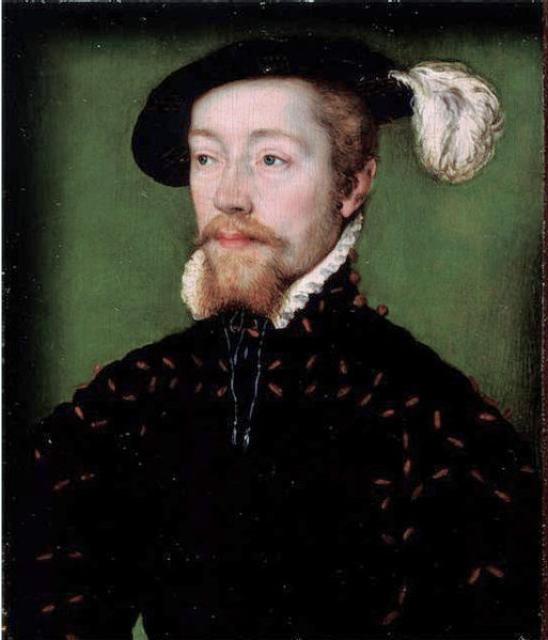
James V of Scotland, the son of Scottish King James IV and Margaret Tudor, sister of King Henry VIII of England, ascended to the throne of Scotland at the age of two following the death of his father in the Battle of Flodden in 1513. The regency council initially led by Queen Margaret Tudor, but her pro-English sympathies and remarriage with the Earl of Angus caused discontent among the Scottish nobility. As a result, the regency was transferred to John Stewart, Duke of Albany, in 1515. During Albany's rule (1515-1524), Scotland's foreign policy was oriented towards France, and the country experienced relative stability internally. Albany's talents and personal authority allowed him to maintain a balance between the two main warring factions, led by the Earls of Arran and Angus. At the same time, pro-English sentiments grew in Scotland.
In 1521, John Major's book "Greater Britain" was published, advocating for the benefits of an Anglo-Scottish union and the creation of a single state in the British Isles. The popularity of this idea led to the failure of Albany's two attempts to organize armed intervention in English territory in 1522-1523, as Scottish nobles refused to participate in the war. Pro-English sentiments were actively supported by King Henry VIII of England, whose main agent in Scotland was the Earl of Angus. In 1524, on the wave of Anglophile sentiments, Albany was removed from the regent's position. It was announced that James V would begin his independent rule, but in reality, power was seized by the Earl of Angus, who held the young king as a prisoner in Edinburgh Castle. Although most Scottish barons refused to support Angus' government, the rebellion led by the Earl of Lennox in 1526 to free the king failed, and Lennox himself was killed. It was only in 1528 that James V managed to escape from Edinburgh with the help of his mother. Scottish nobles rallied under the king's banner and expelled Angus from the country.
Financial Situation at the Beginning of James V's Rule
The financial state of the country at the beginning of James V's independent rule in 1528 was dire. The enormous expenses of Albany's trips to France and maintaining a lavish court, along with the ineffective management of the Earl of Angus and the complete disorganization of the revenue collection system, had depleted the treasury. The central issue of James V's rule in Scotland became the problem of replenishing the budget. The king, known for his extreme scrupulosity in financial matters bordering on greed, managed to find at least three new major sources of income: the dowry of a potential spouse, wealth from the church, and confiscations. Through the mediation of Albany and as compensation for the failed marriage between the king and Catherine de' Medici, Pope Clement VII granted James V the right to collect an annual tax from the Scottish clergy amounting to 10,000 pounds sterling. The funds from this tax were supposed to be used to establish a new supreme judicial court. The court was indeed reorganized by 1540, but a significant portion of the funds collected by royal officials from the clergy went into the treasury directly.
Religious and Political Policies
During James V's reign, Protestant teachings began to penetrate Scotland. In an effort to maintain good relations with Rome, which allowed him to benefit from the wealth of the Scottish church, James V actively persecuted Protestants. Inquisitions and burnings at the stake took place in Scotland. The most famous Protestant burned during James V's reign was Patrick Hamilton, a disciple of Martin Luther. However, there is no evidence that King James V took any measures to eliminate the shortcomings or enhance the authority of the Catholic Church. On the contrary, the complete subordination of the church to royal power was used to extract its wealth and distribute offices. It is worth noting that the richest Scottish abbeys were granted to James V's six illegitimate children.
James V's policy towards the aristocracy was characterized by severity and, at times, vindictiveness, which was unusual for Scottish kings. All those involved in the rule of the Earl of Angus during the king's minority were condemned or executed. James V frequently carried out punitive expeditions against rebellious barons in the border regions. In the Highlands of Scotland, the king went against the traditional policy of relying on the Earls of Argyll and Huntly and instead sought closer ties with the leaders of Gaelic clans. The Earl of Argyll was accused by the king of organizing disorders and was removed from involvement in the administration of the western regions. In 1540, James V sailed around the Orkney and Hebridean Islands, taking oaths from Gaelic leaders and taking hostages.
However, James V also actively dealt with law and order issues and ensuring security in Scotland. The efficiency of the judicial system greatly improved. However, abuse of royal prerogatives was observed in this area as well: any suspicion of conspiracy against the king was punishable by death and confiscation of estates. The king's desire to increase treasury revenues by any means led to the practice of imposing contributions on the aristocracy under the threat of confiscating their lands and the mass sale of royal pardons.
All of this caused dissatisfaction among the Scottish nobility. After 1532, their representatives practically stopped participating in the royal council and other governing bodies. By the end of James V's reign, his circle consisted mainly of clergy and minor landowners. Due to his pronounced concern for the needs of peasants and common citizens, James V earned the nickname "King of the Poor." As a result of confiscations, contributions, and increased land rents, the income of crown estates tripled by the end of his reign. Revenues from dispensing justice also significantly increased. Both of the king's marriages brought large dowries, totaling over 200,000 pounds, as well as numerous precious jewels. Huge amounts were also accumulated through the exploitation of church wealth (taxes on the clergy, distribution of offices).
At the same time, James V embarked on a colossal program of palace construction. During his reign, royal palaces were built in Stirling, Falkland, and Linlithgow, which Queen Mary of Guise considered comparable to the palaces of France. The king also maintained a lavish court and actively acquired precious items and decorations. The unprecedented expenses incurred by the king while pursuing a strict domestic policy caused discontent among the Scottish nobility and their insecurity regarding their own holdings. All of this led to a serious internal crisis, which was exacerbated by the king's foreign policy.
Marriage and Conflicts with England
Throughout his reign, James V sought a financially and politically advantageous bride. Negotiations were held from 1527 to 1531 with Pope Clement VII for James to marry Catherine de' Medici, the pope's grandniece. Options for marriage between the king and the daughter of the King of Denmark and the widow of the King of Hungary were also considered. Later, the king managed to convince France of the necessity of a dynastic alliance, and on January 1, 1537, James V married Madeleine of France, the daughter of King Francis I, who brought a dowry of 100,000 pounds to the king's treasury. However, Madeleine died a few months after the wedding. James V then married Mary of Guise, daughter of Claude, Duke of Guise. On May 10, 1538, Mary arrived in Scotland, and her marriage to the king took place shortly after. The second marriage brought the king an additional 150,000 pounds as a dowry. James V, who had suffered in his youth from the actions of the pro-English faction led by the Earl of Angus, maintained hostility towards England throughout his reign. However, while the Anglo-French truce was in effect, this hostility was not realized, and there were even negotiations for a possible marriage between the king and Mary, the elder daughter of King Henry VIII of England. However, Henry VIII's break with the Pope, severe persecution of Catholics in England, and James V's dynastic alliance with France in the late 1530s greatly strained Anglo-Scottish relations.
In September 1541, a meeting between the kings of both British realms was organized in York at the proposal of the King of England. However, fearing his capture, James V refused to attend the negotiations, causing a furious response from Henry VIII, who made the unprecedented journey to York. The English army invaded Scottish territory in August 1542 but was defeated by the Earl of Huntly in the Battle of Haddon Rig. James V called for a Scottish militia, but most Scottish nobles, dissatisfied with the king's domestic policies, refused to participate. Angry and abandoned by all, the king returned to his Falkland Palace, where he died on December 14, 1542.
James V had at least seven illegitimate children, the most famous of whom were James Stewart, Earl of Moray, and John Stewart, Prior of Coldingham.