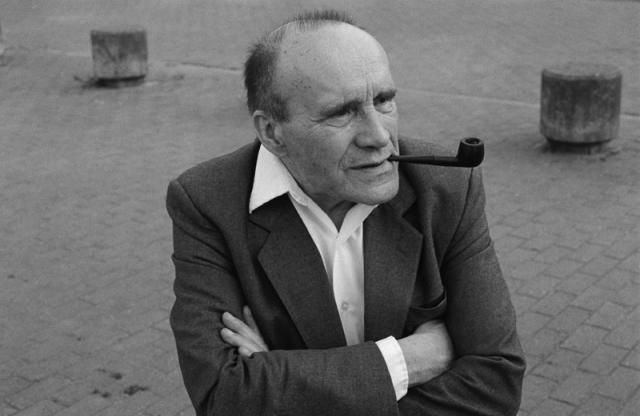
Jan Jozef Szczepanski
 Poland
Jan Józef Szczepański was a Polish novelist, short-story writer, essayist, reporter, translator, and screenwriter whose work joined the hard facts of history to searching questions about personal responsibility. A soldier in the 1939 campaign and later a member of the Home Army resistance, he wrote about war without turning it into easy legend. He was also a mountaineer, yachtsman, and traveler whose journeys supplied material for vivid reportage. Born in Warsaw on January 12, 1919, he died in Kraków on February 20, 2003.
War and education
Szczepański studied oriental studies at the University of Warsaw before the Second World War. He fought in Poland’s September Campaign in 1939 and was taken prisoner by Soviet forces. After escaping from a transport, he settled in Kraków, where he continued his education clandestinely at the Jagiellonian University. During the occupation, he joined the underground and served in the Home Army, including in partisan activity.
The war became central to his writing, but he resisted simplifying its moral choices. He began work on his novel Polska jesień (Polish Autumn) during the conflict, drawing on the collapse of 1939 and the experience of ordinary soldiers. The book’s restrained, documentary quality set it apart from more triumphant accounts. It was published in 1955 after years of delay and pressure to alter it. In 1959, it earned him a prize funded by Ernest Hemingway.
Literary career
Szczepański made his literary debut in 1943 in the underground journal Droga, using the pen name Roman Konarski. After the war, he worked with the Kraków weekly Tygodnik Powszechny, writing reviews and stories, and later held a literary position at the Groteska Theatre in Kraków. He built a body of work across fiction, essays, reportage, translation, and film.
His early books included the novel Portki Odysa (Odysseus’s Shorts, 1954), Polska jesień, the story collection Buty i inne opowiadania (Boots and Other Stories, 1956), and Pojedynek (The Duel, 1957). The stories in Buty turned a clear-eyed gaze on the everyday lives of partisans, including the less heroic realities of resistance. In historical novels such as Ikar (Icarus, 1966) and Wyspa (The Island, 1968), he explored idealism, isolation, and the costs of political violence.
Ethical questions remained at the center of his essays. Przed nieznanym trybunałem (Before an Unknown Tribunal, 1975) reflects on the sources of moral judgment beyond formal religious doctrine. His characters often face situations in which every choice carries a cost. Rather than offering easy heroes, he examined weakness, self-deception, and the dignity people try to preserve under pressure.
Szczepański was also an accomplished reporter. His travels included an expedition to Spitsbergen and voyages on commercial ships to India, East Africa, South Africa, and South America, as well as journeys through Europe and Asia. Books such as Zatoka białych niedźwiedzi (Bay of White Bears, 1960) and Do raju i z powrotem (To Paradise and Back, 1964) brought those encounters to readers. His range extended to screenwriting, including work on the films Westerplatte and Wolne miasto (Free City).
Public life and independence
Szczepański’s refusal to submit his writing to political pressure eventually brought him into open conflict with the communist authorities. He signed the 1975 Letter of 59, a protest against proposed constitutional changes, and became involved with independent opposition circles. At times, censorship and informal bans kept his books from publication or obstructed the recognition of his work.
In December 1980, he became president of the Polish Writers’ Union. After martial law was imposed in 1981, the authorities moved to suspend and ultimately dissolve the organization. Szczepański tried to preserve its independence and negotiated on behalf of detained members of the opposition. He recorded that struggle in Kadencja (Term of Office, 1986), published underground.
As political change gathered pace, he took part in the 1989 Round Table talks. He helped establish the Polish Writers’ Association and became its first president, later serving as honorary president. His public role reflected the same concerns found in his fiction: intellectual freedom, integrity, and the obligations people have to one another.
Legacy
Jan Józef Szczepański’s career resisted narrow labels. He was both an adventurer and a careful observer, a writer of war and travel, and an essayist concerned with ethics. His prose is noted for its moral seriousness and skepticism toward heroic posturing. Through novels such as Polish Autumn, stories such as Boots, and the memoir of his fight to protect the writers’ union, he left a record of people tested by history and of a writer determined to preserve independent judgment.