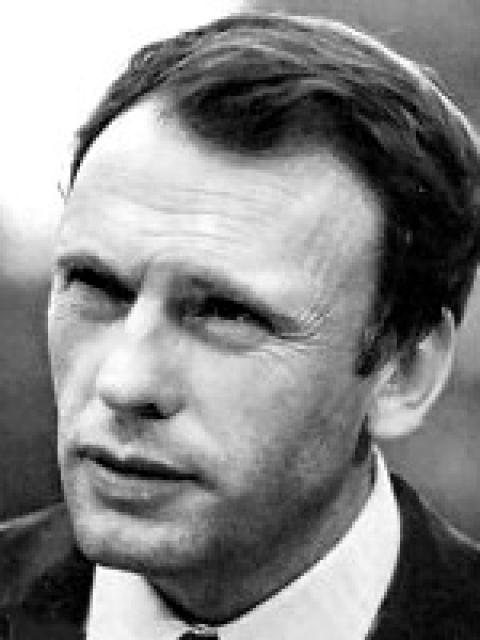
Jean Trintignant
 France
- Jean-Louis Trintignant: A Global Icon from France
- Rise to Prominence
- International Stardom
- Versatile Performances
- Social and Political Commentary
- Collaborations and Personal Life
- Legacy and Recognition
Jean-Louis Trintignant: A Global Icon from France
Early Life and EducationJean-Louis Trintignant was born on December 11, 1930, in the small town of Pont-Saint-Esprit, France. Despite his initial interest in poetry and theater, he pursued law studies at his parents' behest. However, at the age of 19, he made a life-altering decision to enroll in the acting classes of Charles Dullin and Tania Balachova in Paris.
Rise to Prominence
Trintignant's professional acting career commenced in 1951 with contract work at various theaters. Gradually, he ascended to leading roles in classical plays. His cinematic debut occurred in 1955 with a minor role in Christian-Jaque's "If All the Guys in the World." In 1956, he gained recognition as the unassuming husband in Roger Vadim's "And God Created Woman," co-starring Brigitte Bardot, who became his wife at the time.
International Stardom
Trintignant's star power soared internationally with his role in Claude Lelouch's "A Man and a Woman" (1966). His portrayal of a widowed race car driver transformed his earlier image as a pensive romantic into a charismatic and dignified leading man. The film won the Palme d'Or at the Cannes Film Festival and an Academy Award.
Versatile Performances
In the 1960s, Trintignant showcased his versatility in films ranging from thrillers and crime dramas to comedies. He excelled in complex and enigmatic characterizations, including a spy in "Mata Hari, Agent H-21," a detective in "The Sleeping Car Murder," and a professional killer in "Flic Story."
Social and Political Commentary
Trintignant used his acting skills to tackle socially and politically charged themes. His performance as a principled investigator in Costa-Gavras's "Z" (1968), which exposed a political assassination, earned him critical acclaim. He continued to explore these motifs in films like "The Conformist" (1970) and "Colpire al cuore" (1982), delving into the moral dilemmas of left-wing intellectuals.
Collaborations and Personal Life
Trintignant collaborated with several renowned European directors, including Alain Robbe-Grillet, Bernardo Bertolucci, Krzysztof Kieslowski, and François Truffaut. In 1971, he married director Nadine Trintignant, with whom he had a daughter, Marie Trintignant, also an accomplished actress.
Legacy and Recognition
Despite his immense global fame, Trintignant never received the prestigious César Award in his home country of France. However, he remains universally acclaimed as one of the greatest cinema icons. His filmography spans over a hundred and forty films, encompassing a wide range of characters and emotions that have left an indelible mark on the art of filmmaking.


