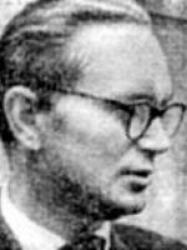
John Collier
 Great Britain
- Childhood and Background
- Early Writing in London
- Fantasy, Short Stories and Hollywood
- Later Years and Legacy
John Collier built a literary career on elegant unease. His stories could begin in an ordinary drawing room or city street, then turn sharply toward the uncanny, the macabre or the absurd. That gift for polished, wickedly controlled fantasy made him a distinctive short-story writer and eventually carried him from interwar London to Hollywood, where he worked for decades as a screenwriter.
Childhood and Background
John Henry Noyes Collier was born in Brixton, London, on May 3, 1901. His father, John George Collier, worked as a commercial clerk, while his mother, Emily Mary Noyes, taught in a kindergarten. Collier later grew up with an unusually informal education: apart from a short period at a preparatory school, he was taught at home, chiefly by his mother and his paternal uncle Vincent Collier, who was also a writer. The arrangement left him ample room to read and develop his own literary interests.
Early Writing in London
Collier began writing poetry as a young man, and his first work appeared in print in 1920. In 1921 he moved to Pimlico, intending to make a living as a writer. His father provided an allowance, and Collier also contributed a regular column to the Osaka Mainichi, an English-language newspaper published in Japan. He became part of London’s interwar literary circle, mixing with figures including the Sitwells, E. M. Forster and Wyndham Lewis.
His early books showed a writer already moving between forms and tones. The poetry collection Gemini appeared in 1931 and won a prize from the literary magazine This Quarter. Its poem “Apology” playfully dismissed the poet’s muse in favor of prose, a pointed hint about the direction his career would take. Collier’s first novel, His Monkey Wife, published in 1930, paired a schoolteacher with a chimpanzee and displayed his taste for the strange premise treated with a straight face. He followed it with the novels Tom’s A-Cold and Defy the Foul Fiend.
Fantasy, Short Stories and Hollywood
Collier’s finest reputation grew from short fiction. His stories, many of them published in The New Yorker, are compact and carefully shaped, often building toward a reversal that leaves the reader unsettled as well as amused. “Bottle Party,” “Green Thoughts,” “Thus I Refute Beelzy,” “De Mortuis” and “The Chaser” became among his best-known pieces. The last was adapted for The Twilight Zone in 1960, bringing one of his sly supernatural tales to a broad television audience.
In 1935 Collier moved from England to Hollywood. He worked there as a screenwriter for roughly three decades, bringing the same sharp eye for character and atmosphere to film assignments. His credits included Sylvia Scarlett, Elephant Boy, I Am a Camera and The War Lord. He also collaborated on an early screenplay for The African Queen, although that version was not used in the finished film. Alongside movies, he wrote extensively for television.
His short-story collections gathered the work that most clearly defined his style. Presenting Moonshine appeared in 1941; Fancies and Goodnights, published in 1951, brought together new and selected stories and became his most celebrated collection. Its blend of fantasy, dark humor and precise craftsmanship earned major recognition in the United States, where his work found a larger readership than it did in Britain. Later collections included Pictures in the Fire, The John Collier Reader and The Best of John Collier.
Later Years and Legacy
Even after establishing himself in Hollywood, Collier kept returning to literary projects. In the late 1960s he devoted considerable effort to adapting John Milton’s Paradise Lost for the screen. The adaptation was eventually published as a book, but the film was never made—a final example of the ambitious projects that accompanied his more practical screenwriting career.
Collier received the International Fantasy Award for Fancies and Goodnights in 1952, and the collection also brought him an Edgar Award. His writing has endured through the contrast at its heart: a calm, cultivated voice describing events that grow steadily less comfortable. He died of a stroke in Pacific Palisades, California, on April 6, 1980, aged 78. His stories remain a distinctive meeting point of fantasy, satire and the macabre, while the television and film adaptations helped carry his imaginative worlds beyond the page.