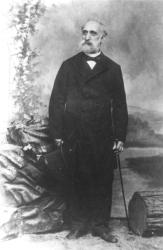
John Ernst Worrell Keely
 USA
USABiography of John Ernst Worrell Keely
John Ernst Worrell Keely was born in 1837 in Chester, Pennsylvania. He grew up as an orphan, raised by his grandparents. Before delving into the field of science, Keely worked as a carpenter, a carnival barker, a theater musician, an artist, and a mechanic. His diverse range of abilities spoke to his curious and versatile nature.
In 1885, Keely made a loud declaration that he had invented a fundamentally new mechanism that could be set in motion by sound vibrations. According to his claims, he extracted sounds using ordinary tuning forks, and sympathetic vibrations resonated with the ether. To understand Keely's construction, one must imagine a copper sphere, 30 centimeters in diameter, supported by a tripod. Around the base of the tripod, Keely placed several metal rods of different lengths and thicknesses, which vibrated upon contact. Inside the sphere, he installed plates and resonant tubes that could be repositioned using special handles. Keely referred to this invention as the sympathetic transmitter.
Another notable experiment involved a glass cylinder filled with water, approximately one meter tall, with a metal lid connected to the sphere by a wire. At the bottom of the vessel were three metal balls weighing two kilograms each. The goal was to demonstrate that each ball, like any other material object, had its own internal melody. Gathering scientists, Keely demonstrated that when he vibrated the tuning forks, which he made sound using his handles, one ball reluctantly swung upward, ending up just beneath the lid of the vessel. The other two balls followed suit.
Keely also showcased other "discoveries," such as an impressive experiment with a large metal wheel that he set in motion using the same tuning forks. Enchanted spectators witnessed the wheel spinning faster and faster, while Keely provided scientific explanations of the process. Soon, due to his strange yet fascinating experiments, Keely became incredibly popular in America, and people constantly flocked to his laboratory, where he eagerly demonstrated the marvels of physics, hailing them as a celebration of human thought and the power of nature.
John Worrell Keely claimed to have invented the "perpetual motion machine" that operated on "etheric force." Investors agreed to establish the "Keely Motor Company" to finance his further research and experiments. Indeed, Keely's newly discovered form of energy required substantial investment.
However, despite the investors' demand to quickly obtain and practically apply the "perpetual motion machine," Keely was in no hurry to reveal the secrets of generating this new type of energy. Only after the scientist's death did his grand deception come to light, later referred to as a brilliant fraud. It turned out that his house and laboratory were equipped with devices powered by compressed air, which, unbeknownst to others, set his "perpetual motion machine" in motion.
Scientifically proving Keely's deception was still not possible, as there were still no explanations for all of his experiments from a physics standpoint. To truly understand Keely's actions, one would need to possess an extensive knowledge of physics. His concepts were extremely complex, and it would be unfair to dismiss Keely as a mere charlatan. He was genuinely brilliant, and his experiments encompassed more than just physical phenomena, as many believe.
John Ernst Worrell Keely passed away on November 18, 1898, in Philadelphia due to pneumonia. He was buried in the West Laurel Hill Cemetery.
Today, Keely is nearly forgotten, and even his old house in Philadelphia no longer exists—replaced by a parking lot. However, several of his models are still preserved in the collection of the Franklin Institute in Philadelphia and the American Precision Museum in Windsor, Vermont.