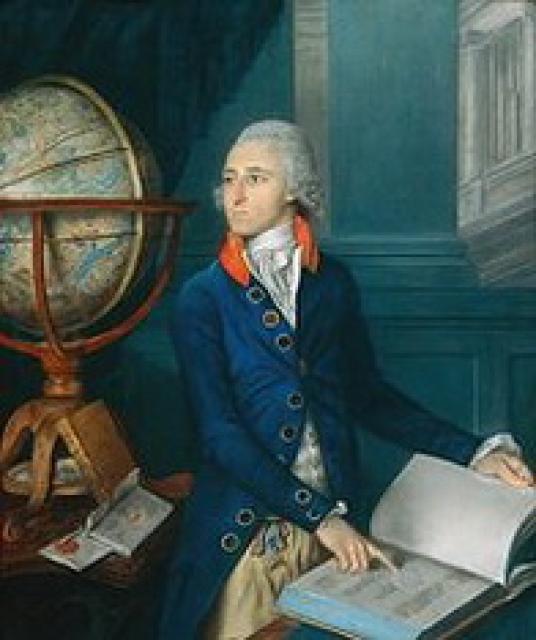
John Goodricke
 Great Britain
- John Goodricke: A Pioneering Astronomer
- Education and Early Influences
- Astronomical Discoveries
- Recognition and Legacy
John Goodricke: A Pioneering Astronomer
John Goodricke, an English astronomer and a Fellow of the Royal Society of London, was born in Groningen, Netherlands, in 1764. He spent most of his life in England and became a renowned figure in astronomy despite losing his speech and hearing due to scarlet fever in his early childhood.
Education and Early Influences
Goodricke received his education at Thomas Braidwood's Academy, a school for the deaf in Edinburgh, from 1778 to 1781. He then studied at the Warrington Academy from 1781 to 1784. Upon returning to his parents in York, he met Edward Pigott, whose father owned a private observatory. Pigott recognized Goodricke's keen interest in science and introduced him to astronomy.
Astronomical Discoveries
In 1783, while observing the variable star Algol (β Persei), Goodricke made a groundbreaking discovery. He proposed that the star's varying brightness was caused by an eclipse of the star by a larger rotating body, a mechanism that is now known as an eclipsing binary star. For this hypothesis, presented to the Royal Society of London in May 1783, Goodricke received the Copley Medal. He went on to discover the variability of the stars η Lyrae and δ Cephei, which became prototypes of two classes of variable stars.
Recognition and Legacy
On April 16, 1786, Goodricke was elected a Fellow of the Royal Society of London. However, tragedy struck just four days later when he died from pneumonia at the young age of 21.
Goodricke's ingenious deduction was confirmed in 1889 when periodic shifts in the spectral lines of Algol were observed. His name is commemorated in the Goodricke-Pigott Observatory in the United States. In 2012, the John Goodricke Society was established in Armenia by a group of amateur astronomers.



