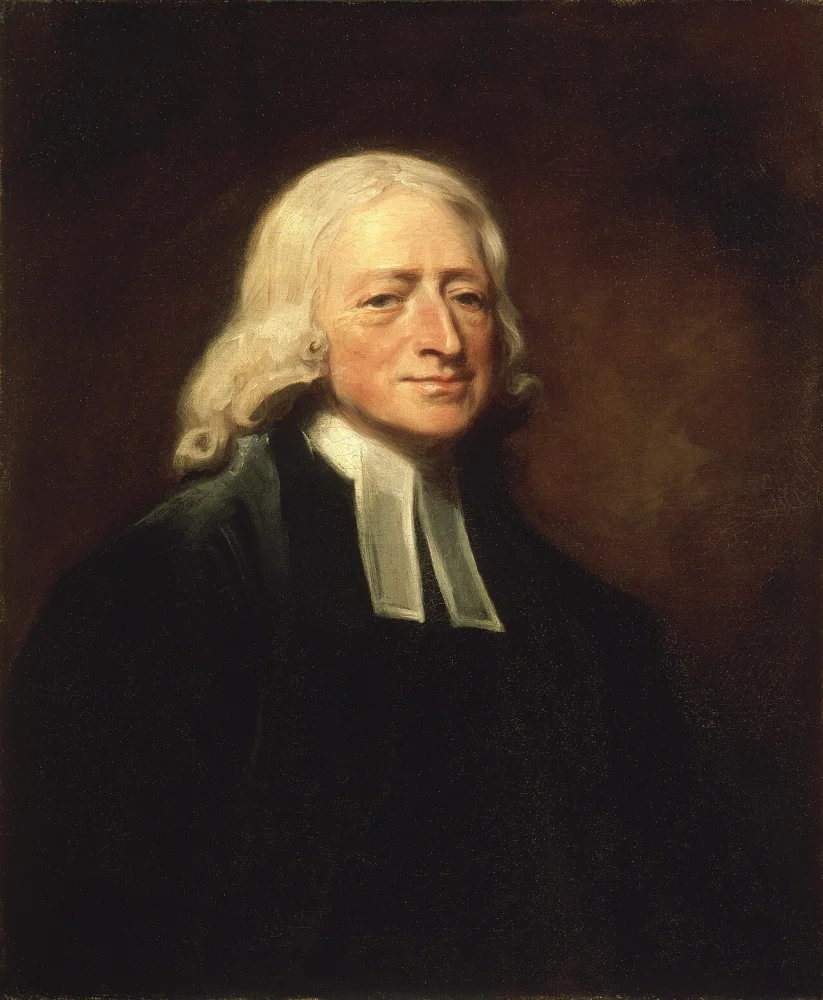
John Wesley
- Childhood and Education
- Georgia and Aldersgate
- Building the Methodist Movement
- Personal Life
- Later Years and Legacy
John Wesley was an Anglican priest whose tireless preaching and close-knit religious societies gave rise to the Methodist movement. He traveled thousands of miles, spoke to crowds in fields and marketplaces, and organized ordinary believers into a disciplined network that spread far beyond Britain. Though remembered as Methodism’s founding leader, he spent most of his life insisting that the movement remain within the Church of England.
Childhood and Education
Wesley was born on 17 June 1703 at Epworth Rectory in Lincolnshire, one of the many children of Samuel Wesley, the local rector, and Susanna Wesley, who oversaw the children’s education. A dramatic event became central to his own understanding of his life: in 1709, when the rectory caught fire, five-year-old John was rescued from an upstairs window shortly before the roof collapsed. His family later regarded the escape as providential, and Wesley described himself as a “brand plucked from the burning.”
He attended Charterhouse School in London and entered Christ Church, Oxford, in 1720. After earning his degree, he was ordained as an Anglican deacon in 1725 and priest in 1728. At Oxford, he joined the small group of students led by his younger brother Charles, who met regularly for prayer, study, fasting, and charitable work. Their structured habits earned them the mocking nickname “Methodists”—a label that would eventually name a worldwide religious tradition.
Georgia and Aldersgate
In 1735 Wesley sailed to the British colony of Georgia, hoping to serve as a missionary. The experience was difficult, and he returned to England in 1738 with serious doubts about his own faith. On 24 May that year, at a religious meeting in Aldersgate Street, London, he felt a new assurance of faith. He later described his heart as “strangely warmed.” The experience marked a turning point in his preaching and spiritual life.
Wesley’s ministry developed alongside that of George Whitefield, who encouraged him to preach outdoors to people who rarely attended church. Although Wesley initially hesitated, he began speaking to miners and workers in the open air. Crowds gathered, and his message of conversion, disciplined Christian living, and salvation by faith reached people who stood outside the usual structures of parish life.
Building the Methodist Movement
Wesley organized converts into local societies and smaller classes, where members met regularly for prayer, mutual support, and accountability. He trained lay preachers to carry the message across Britain and traveled constantly to oversee the growing network. His administrative energy was as important as his sermons: Methodist societies had a structure capable of surviving and expanding beyond the charisma of a single preacher.
The growing movement faced opposition from some Anglican clergy, and Wesley’s practice of preaching outside church buildings challenged conventional boundaries. Yet he resisted a formal break with the Church of England. Methodism developed as a renewal movement within Anglicanism during his lifetime; a distinct Methodist church emerged later, especially in the United States after the American Revolution.
Wesley wrote prolifically, edited religious texts, compiled hymns and sermons, and published practical guides to Christian life. He also opposed slavery. In his 1774 pamphlet Thoughts upon Slavery, he condemned the slave trade and the treatment of enslaved people, and near the end of his life he encouraged the abolitionist William Wilberforce.
Personal Life
In 1751 Wesley married Mary Vazeille, a widow with children from her previous marriage. The relationship was unhappy and eventually ended in separation. They had no children together. His brother Charles was a close collaborator in the Methodist movement and a prolific hymn writer, though their views and working relationship did not always align.
Later Years and Legacy
Wesley continued traveling and preaching into old age. He died in London on 2 March 1791, aged 87, after a ministry that had reshaped British religious life. The movement he organized grew into Methodist churches around the world.
His legacy rests on the combination of spiritual intensity and practical organization. Wesley challenged the limits of where preaching could happen, built a disciplined community for people often overlooked by established churches, and left a body of writing that continues to shape Methodist theology and practice.