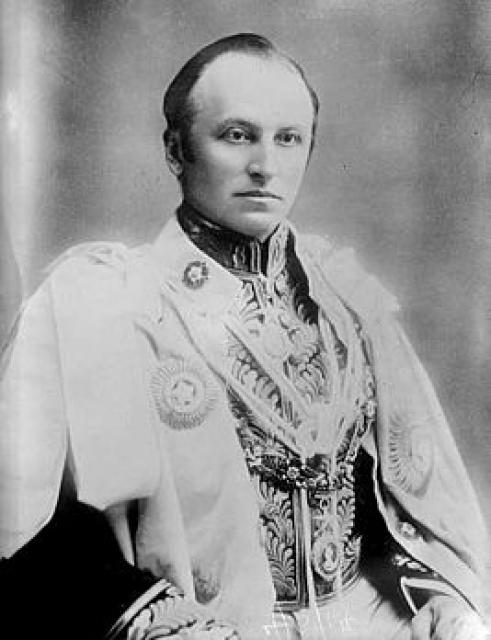
Jordg Kerzon
 Great Britain
- Lord Curzon, Marquis of Kedleston
- Political Career
- Viceroy of India (1898-1905)
- Return to British Politics
- Foreign Policy
- Marquis of Kedleston and Later Years (1921-1925)
Lord Curzon, Marquis of Kedleston
Birth and Early LifeBorn on January 11, 1859, in Kedleston, Derbyshire, George Nathaniel Curzon was a British aristocrat and politician.
Political Career
After graduating from Oxford University, Curzon entered Parliament as a Conservative in 1886. He held the positions of Under-Secretary of State for India (1891 and 1892) and Under-Secretary of State for Foreign Affairs (1895). During his time outside government, Curzon traveled extensively in Asia, becoming an expert on Asian affairs. He wrote several books, including "Persia" (1892).
Viceroy of India (1898-1905)
In 1898, Curzon was appointed Viceroy of India and raised to the peerage as Baron Curzon of Kedleston. As Viceroy, he reformed taxation and implemented a strong policy of preserving Indian monuments, notably restoring the Taj Mahal. However, he clashed with his Commander-in-Chief, Lord Kitchener, and was forced to resign.
Return to British Politics
Upon his return from India, Curzon was elevated to the House of Lords and joined Lloyd George's coalition cabinet in 1915. He became one of four ministers in the War Cabinet and, in 1919, was appointed Foreign Secretary.
Foreign Policy
As Foreign Secretary (1919-1924), Curzon played a key role in negotiating the Treaty of Lausanne, which ended the conflict with Turkey. He aimed to maintain friendly relations between France, Germany, and Britain, and was instrumental in establishing the Dawes Committee on reparations.
Marquis of Kedleston and Later Years (1921-1925)
In 1921, Curzon was elevated to the rank of Marquis of Kedleston. When Bonar Law resigned as Prime Minister in 1923, Curzon expected to succeed him, but King George V appointed Stanley Baldwin instead. Curzon died in London on March 20, 1925.