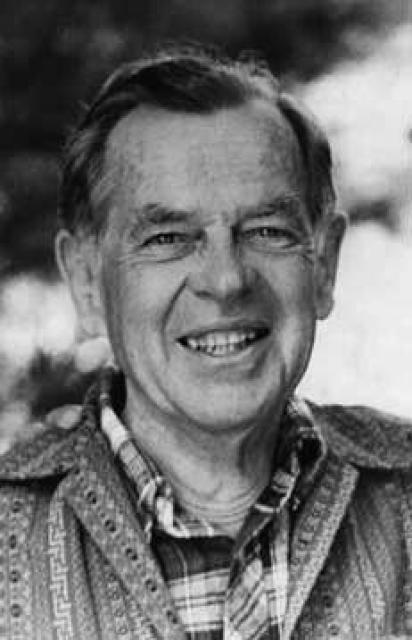
Joseph John Campbell
 USA
USA- Biography of Joseph John Campbell
- Early Life and Education
- Career and Influences
- Mythological Studies and Later Works
Biography of Joseph John Campbell
Joseph John Campbell was an American mythologist who gained great popularity after a series of television interviews with journalist Bill Moyers in 1985 and 1986. He also became known as the inspiration behind the film "Star Wars" with his book "The Hero with a Thousand Faces", according to George Lucas.
Early Life and Education
Joseph Campbell was born in New York in 1904 into an Irish family. His parents, Charles and Josephine Campbell, provided him with a good education. Campbell studied Catholicism in a parish school and developed a strong interest in Native American traditions. As a child, he read extensively and noticed similarities between Native American myths and the Bible. He enrolled at Columbia University in 1921, where he continued his studies in foreign languages, literature, anthropology, and philosophy.
Career and Influences
After obtaining his master's degree in medieval literature in 1926, Campbell lived in Paris and Munich for two years, studying Romance philology and Sanskrit. He was deeply influenced by the works of James Joyce and Thomas Mann, the ideas of Adolf Bastian on elementary ideas, the cultural cycle theories of ethnologist Leo Frobenius, and the theories of dreams and the unconscious by Sigmund Freud and Carl Jung.
Campbell began his teaching career in 1934 at Sarah Lawrence College, where he worked until 1972. While his first major scholarly work, "A Skeleton Key to Finnegans Wake" (1944, co-authored with Morton Robinson), focused on literature, he soon shifted his focus to the study of mythology. He was strongly influenced by German indologist Heinrich Zimmer, who saw Indian myths as timeless repositories of spiritual truths. After Zimmer's death in 1943, Campbell edited his manuscripts and published the book "Myths and Symbols in Indian Art and Civilization" (1946) and other important works on Indian philosophy and art.
Mythological Studies and Later Works
Campbell's passion for myths, Eastern religions, and Jungian psychology culminated in his famous study of hero myths, "The Hero with a Thousand Faces" (1949). He followed this with other significant works on comparative mythology. After a trip to India in 1954, Campbell wrote "The Masks of God" (1959-1968), a four-volume exploration of mythology. His goal was to write the history of myths, tracing the "fundamental unity of the spiritual history of humanity" through universally prevalent mythological themes such as the theft of fire, the flood, the land of the dead, the immaculate conception, and the resurrecting hero. Another notable book by Campbell was "The Flight of the Wild Gander" (1969), a collection of essays on the biological, metaphysical, and historical-cultural origins of myths and the secularization of the sacred in the modern world.
After leaving Sarah Lawrence College in 1972, Campbell moved to Honolulu, where he continued his writing career. During this period, he published works such as "Myths to Live By" (1972), which explored the need for new myths in the modern world, "The Mythic Image" (1974), an exploration of the connections between dreams, myths, and art, "The Inner Reaches of Outer Space: Metaphor as Myth and as Religion" (1986), a collection of lectures on mythology, "The Historical Atlas of World Mythology" (1983, 1989), an attempt to trace the origins and spread of myths, and "The Power of Myth".
Joseph Campbell's extensive research and writings have had a profound impact on the field of mythology, inspiring countless scholars, artists, and storytellers. His work continues to be widely studied and celebrated for its insights into the universal themes and patterns that shape human culture and experience.


