Jovanni Veraccano
 Italy
ItalyBiography of Giovanni da Verrazzano
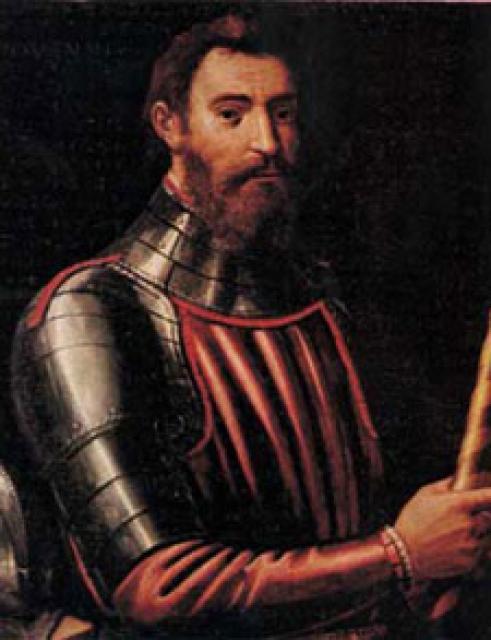
Giovanni da Verrazzano, a Florentine explorer, is often credited with the discovery of the New York Bay, contrary to popular belief that it was discovered by Henry Hudson. Verrazzano, whose birth year is uncertain, was born in either 1480 or 1485. He traveled extensively and eventually settled in France. There is speculation that Verrazzano and the infamous French pirate Jean Florin (Fleury), who attacked Spanish trading ships between Spain and its colonies, were the same person. In 1523, Florin looted a Spanish ship carrying treasures to the Spanish emperor, which were originally plundered by Cortes in Mexico. If Verrazzano and Florin were indeed the same person, this attack explains how he obtained the funds to send a fleet of four ships on a search for China the following year.
The ships encountered a storm, suffered damages, and were forced to return to the shores of Brittany for repairs. After repairing the ships, Verrazzano set sail on one of them initially to the island of Madeira and then further west. Trying to evade a storm, he deviated north from his intended course and arrived at the shores of America around 34° north latitude, between Cape Fear and Cape Hatteras in present-day North Carolina. Verrazzano described a low sandy spit that separated him from the mainland, with water visible beyond it. He struggled to find a passageway or a suitable place to dock. In his search, he sailed south for a short distance, then turned north and eventually reached the mouth of the Hudson River. His description of the spit matches the modern picture of the Carolina coast.
This is what the first European sailors saw when they arrived there in 1524: "We found a very pleasant place enclosed between two small elongated hills, framing the coast of a large bay, deep near its mouth... Since we were anchored in a well-protected place, a short distance from the shore, we did not want to risk without exploring the entrance. Therefore, we entered the river on a small boat, and its shores turned out to be densely populated. People dressed in colorful bird feathers happily ran to the shore, expressing their admiration with loud cries and pointing out the safest place to dock. We sailed about two miles up the river and saw that it formed a magnificent lake about 13 miles in circumference. Native Americans were sailing across the lake in about thirty canoes. Countless crowds gathered at the shores to catch a glimpse of us. Suddenly, as often happens during sea voyages, a storm came from the sea, and we were forced to return to the ship, leaving this land with great disappointment. Not only was it convenient and beautiful but it probably also held great value, as all its hills indicated the presence of minerals."
Verrazzano continued north to the Block or Martha's Vineyard islands, entered Newport (in New England), and reached a heavily forested coast. He then passed by Newfoundland, which had already been visited by Breton sailors. From there, Verrazzano returned to France. His discoveries were later utilized by Jacques Cartier's expedition.
No one knows what happened to Verrazzano afterward, unless he was indeed the pirate Florin. During those distant years, the professions of explorer and pirate were often intertwined, as there was nothing preventing someone from engaging in both. Except, of course, the law, which was strict, swift, and inevitable. So, if the respected Verrazzano and the pirate known as Fleury were one and the same, his fate is known - he was captured by the Spanish in 1527 and hanged. The river and bay he had discovered were later rediscovered by Henry Hudson and named after him. However, Americans in modern times have sought to restore historical justice by naming one of the world's largest bridges in New York after Verrazzano.