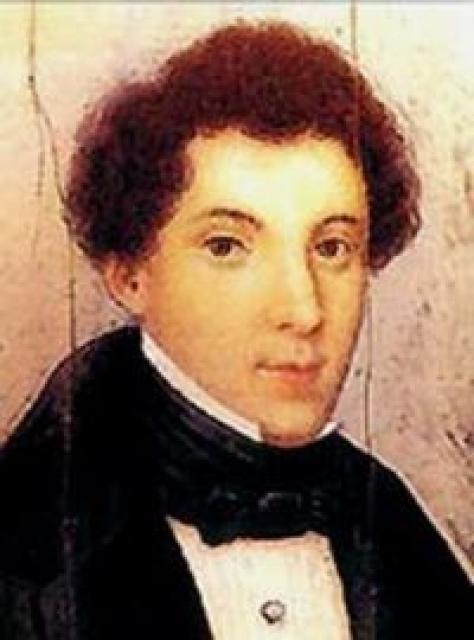
Juan Crisostomo Arriaga
 Spain
SpainBiography of Juan Crisóstomo Arriaga
Juan Crisóstomo Jacobo Antonio de Arriaga y Balzola, also known as the 'Spanish Mozart', was born in Bilbao, Biscay, in 1806. From a young age, he showed great talent in music, similar to Wolfgang Amadeus Mozart. Arriaga's father and older brother were his first music teachers. He then studied violin under the guidance of Pierre Baillot, a Frenchman, and counterpoint and harmony under François-Joseph Fétis, a Franco-Belgian, at the Paris Conservatoire.
Arriaga's exceptional talent led Fétis to appoint him as his assistant at the conservatory. Unfortunately, his life was cut short when he fell ill and passed away in January 1826, just a few days before his 20th birthday. The exact cause of his death remains uncertain, but it is believed to be either a lung disease or exhaustion, possibly both.
Despite his premature death, Arriaga left behind a small body of work, earning him the title of the 'Spanish Mozart'. One of his notable compositions is the opera 'Los esclavos felices' ('The Happy Slaves'), written when he was only 13 years old and performed in Bilbao. Only overtures and fragments of this opera have survived to this day. His Symphony in D, which includes both D major and D minor tonalities, is considered one of the most important works in his short career as a composer.
Arriaga also wrote three brilliant and idiomatic string quartets before the age of 17, which were the only published works during his lifetime. In addition, he composed an octet titled 'Nada y Mucho' and created several religious music pieces, including 'Mass' (lost), 'Stabat Mater', 'Salve Regina', and 'Et vitam venturi saeculi' (lost), as well as cantatas such as 'Agar', 'Erminia', 'All' Aurora', and 'Patria'. Among his instrumental compositions are a nonet, Variations for String Quartet, and numerous romances.
According to the 'New Grove Concise Dictionary of Music', Arriaga's music is described as elegant, refined, and characterized by warm harmony. Interestingly, his compositions lack any distinct national motifs, with no trace of either Spanish or Basque music. He drew inspiration from international (European) music, ranging from the late classical era of Mozart to the early romanticism of a young Beethoven.
Arriaga's untimely death at the age of 20 was a tragic loss for Basque musical heritage. Following his death, the only reliable biographical information about him was provided by Fétis, which later became embellished with fictional details aiming to promote Basque nationalism. In his hometown of Bilbao, a monument was erected in his honor, and an opera theater bears his name.



