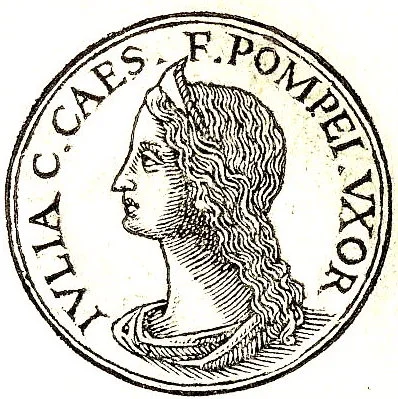
Julia
Julia’s life is known mainly through the men around her, yet her marriage placed her at the center of Roman politics. As the daughter of Julius Caesar and the wife of Pompey the Great, she linked two ambitious leaders whose partnership helped shape the final years of the Roman Republic. Ancient writers also remembered the marriage as unusually affectionate, giving Julia a personal importance beyond its political purpose.
Daughter of a rising Roman politician
Julia was the only child of Caesar and his wife Cornelia. The surviving record says little about her childhood, and her exact birth year is uncertain. She grew up in a Roman elite where marriages could seal political relationships as well as unite families.
In 59 BCE, Caesar arranged for Julia to marry Pompey, then one of Rome’s most influential generals and statesmen. The union helped strengthen the alliance between Caesar and Pompey, who were working with Marcus Licinius Crassus in the political partnership later called the First Triumvirate. Although the match served political aims, later accounts describe Julia and Pompey as deeply devoted to each other. Plutarch presents her as a bond of affection between men whose rivalry might otherwise have become more immediate.
A brief life with public consequences
Julia’s marriage brought her into a household at the center of Roman power. Her husband was substantially older, and his military and political career often took him away from Rome. Nevertheless, ancient writers say that the couple’s mutual attachment was striking. Such accounts are filtered through the values and storytelling of classical authors, but they suggest that contemporaries saw the marriage as more than a cold political arrangement.
In 54 BCE, Julia died while giving birth. The child survived her only briefly, according to Plutarch. Her death removed a personal connection between Caesar and Pompey at a time when their political interests were beginning to diverge. The following year, Crassus was killed in battle at Carrhae. With both the marriage tie and the third partner gone, the political alliance weakened further. Caesar and Pompey eventually became enemies, and their struggle led to civil war.
Memory and legacy
Julia’s father later honored her with public funeral rites and games. Her burial in the Campus Martius, a prominent area of Rome, reflected the public attention her death received. Roman narratives treated her passing as a turning point, though it was one of several events that contributed to the breakdown of the political balance.
Because so few independent details about her life survive, Julia can be difficult to separate from her father’s and husband’s stories. Still, her marriage mattered in both private and public terms. It temporarily joined two powerful men through family ties, and ancient accounts remembered her as a cherished wife whose death intensified the sense that their partnership was unraveling.