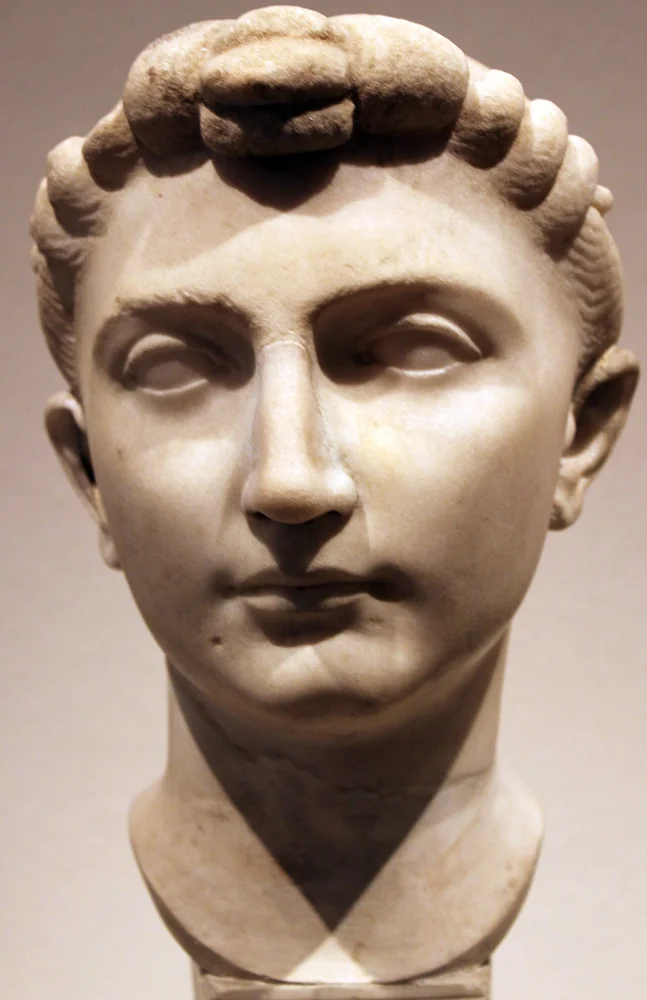
Julia the Elder
Julia the Elder was the only biological child of Augustus, Rome’s first emperor, and a central figure in the dynasty he worked to establish. Her marriages linked her to leading members of the imperial family, and her children were promoted as heirs to the new regime. In 2 BCE, however, Augustus sent her into exile after accusing her of adultery. Her story survives largely through male Roman writers, whose accounts mix political history with moral judgment.
Daughter of the New Regime
Julia was born in 39 BCE to Octavian, the future Augustus, and his second wife, Scribonia. Her parents divorced shortly after her birth, and she was raised in the household of her father and his later wife, Livia. As Augustus’s only daughter, she held an unusual place in Roman politics: her marriage and children could strengthen the legitimacy of a ruling family whose power had emerged from civil war.
Her first marriage, arranged in 25 BCE, was to Marcellus, Augustus’s nephew and an expected successor. Marcellus died two years later, and in 21 BCE Julia married Marcus Agrippa, Augustus’s trusted general and political partner. They had five children: Gaius and Lucius Caesar, Julia the Younger, Agrippina the Elder, and Agrippa Postumus. Augustus adopted the two eldest boys and presented them as future leaders, making Julia the mother of the dynasty’s next generation.
After Agrippa died in 12 BCE, Julia married Tiberius, Augustus’s stepson. The match tied Tiberius more closely to the Julian family, but their relationship was strained. Tiberius later withdrew from public life and went to Rhodes, while Julia remained in Rome. She was expected to take part in public ceremonies and elite social life, roles that made her both visible and vulnerable to gossip.
Exile and Political Scandal
In 2 BCE, Augustus accused Julia of adultery and banished her to the island of Pandateria, now Ventotene. She was divorced from Tiberius and subjected to severe restrictions. Her mother Scribonia is said to have accompanied her in exile. The surviving accounts also describe the punishment of men accused of involvement with Julia, including the execution of Iullus Antonius, a prominent Roman aristocrat.
Ancient writers portrayed the scandal as a moral failure, particularly because Augustus had promoted laws regulating marriage and adultery. Modern historians have also considered whether political opposition or a perceived threat to the succession lay behind the charges. The evidence does not settle the question, and the accounts were written in a political culture that often interpreted women’s sexuality as a matter of state. Julia’s own perspective is largely absent from the historical record.
After several years on Pandateria, she was permitted to live on the Italian mainland at Rhegium, though she remained under restriction and was excluded from her father’s will. Augustus died in 14 CE; Julia died later that year, still in exile.
Legacy
Julia’s life was shaped by the demands of dynastic politics. Her marriages served the ambitions of Augustus, and her children were placed at the center of the imperial succession. The early deaths of Gaius and Lucius altered those plans, while Julia’s exile further unsettled the family’s public image.
For centuries, Roman histories have presented her chiefly as a cautionary figure in stories about adultery, discipline, and imperial morality. Reading those accounts alongside the political context makes her more than a scandal: she was a mother, a public representative of the Augustan dynasty, and a woman whose fate was decided by the emperor who was also her father.


