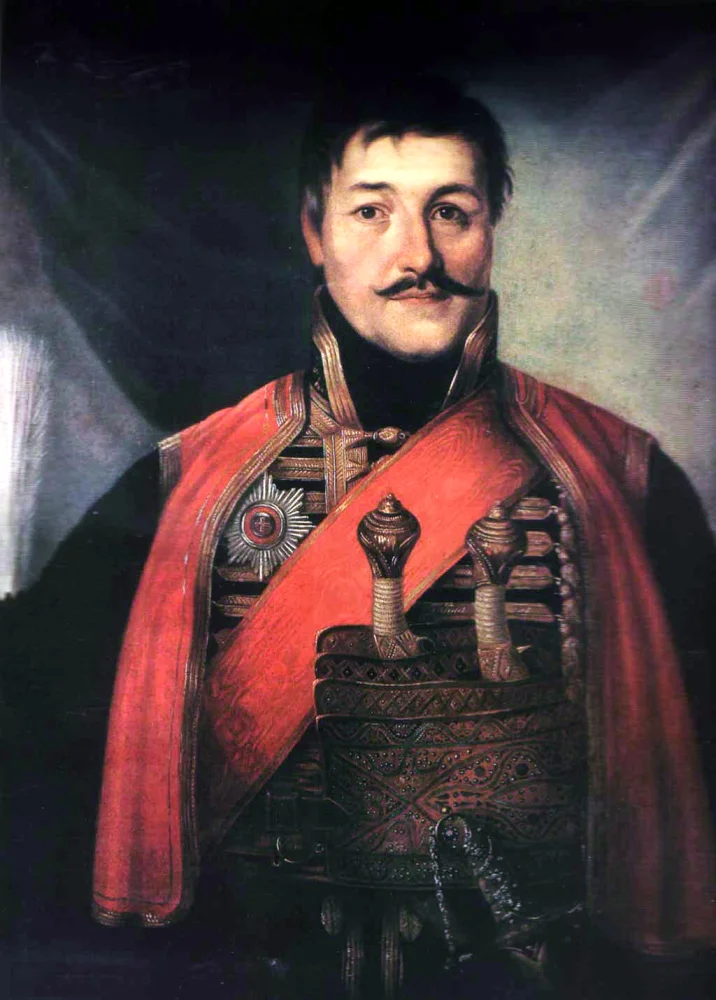
Karađorđe
Karađorđe, born Đorđe Petrović, rose from the turbulent Ottoman frontier of Šumadija to lead the First Serbian Uprising. A forceful military commander with a reputation that inspired both loyalty and fear, he helped turn a local revolt into a movement for Serbian self-government. His defeat in 1813 did not end his influence: he became the founding figure of the Karađorđević dynasty and a lasting symbol of the struggle for Serbian independence.
Early life
He was born in the village of Viševac in 1768, in the Ottoman-controlled Sanjak of Smederevo. The exact details of his childhood are not well documented. He grew up in a rural society where local communities faced heavy taxation and political instability, while powerful Janissary commanders, known as dahijas, increasingly ruled the region with violence and little regard for Ottoman authority.
The name Karađorđe is commonly translated as “Black George.” Accounts connect the nickname to his dark appearance and formidable character. As a young man he took part in the Austro-Turkish War of 1788–1791, serving with the Serbian Free Corps, a Habsburg-supported force. That experience introduced him to organized military service. He later lived for a time outside Serbia, then returned as Ottoman control shifted again.
Leader of the First Serbian Uprising
In 1804, after the dahijas had executed a number of prominent Serbs in what became known as the Slaughter of the Knezes, local leaders gathered at Orašac to organize resistance. They selected Karađorđe to lead them. The uprising began as a fight against the renegade commanders, but it soon widened into a challenge to Ottoman rule and a campaign for autonomy.
Karađorđe proved an energetic and determined commander. Rebel forces scored important victories, captured towns, and took Belgrade in 1806 after a long siege. Alongside the military campaign, the insurgents began building institutions for governing the territory they controlled, including a Governing Council. The emerging Serbian administration was fragile and dependent on the course of the war, but it gave the revolt a political structure as well as an army.
The insurgency faced serious obstacles. Serbia’s leaders disagreed over authority and strategy, and the rebels depended on outside support that could be withdrawn when the great powers’ priorities changed. After Russia made peace with the Ottoman Empire in 1812, Ottoman forces renewed their campaign. By 1813 the uprising had collapsed, and Karađorđe and many other leaders fled across the border into Habsburg lands. He was detained there for a time before eventually making his way to the Russian Empire.
Return and death
Karađorđe spent several years in exile, but he remained committed to returning to Serbian politics. In 1817 he secretly re-entered Serbia, amid renewed efforts to organize resistance and in a period when Miloš Obrenović had become the leading figure in a new uprising and the resulting negotiations with the Ottomans. Karađorđe was killed soon after his return, on the night of July 25–26, at Radovanje. His killing was ordered by Obrenović, who viewed the returning commander as a threat to his position.
His death sharpened the rivalry between the Karađorđević and Obrenović families, whose competing claims would shape Serbian politics for generations. Karađorđe’s son Aleksandar later became prince of Serbia, and the Karađorđević line eventually produced several Serbian and Yugoslav monarchs.
Legacy
Karađorđe’s career ended in defeat and assassination, yet the uprising he led opened a new chapter in Serbian political life. The revolt did not secure lasting independence during his lifetime, but it helped establish the institutions and ambitions that later movements would build on. Remembered as a bold commander and a founder of a dynasty, he occupies a central place in Serbia’s national history.