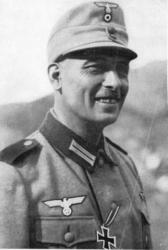
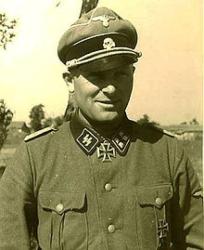
Karl Hermann Frank
 Czech
Czech- Biography of Karl Hermann Frank
- Involvement with the Nazi Party
- Rise to Power in Czechoslovakia
- Consolidation of Power
- Downfall and Execution
Biography of Karl Hermann Frank
Karl Hermann Frank, an SS Obergruppenführer, SS and Police General, was a prominent figure in the Nazi Sudeten German Party and one of the leaders of the occupation regime in Czechoslovakia. He was born on January 24, 1898, in Karlsbad, to a family of teachers. Karl studied law at Prague University but was recruited into the Austro-Hungarian army at the end of World War I. After the war, he worked as an accountant while actively participating in the activities of right-wing Sudeten organizations, such as Kameradschaftsbund.
Involvement with the Nazi Party
Due to his radical views and strong support for the annexation of the Sudeten region by Germany, Karl Hermann Frank joined the Sudeten National Socialist Workers' Party (DNSAP) in 1919. He opened a bookshop, which distributed Nazi propaganda literature until 1933. After the party was suppressed by the Czechoslovak government, he collaborated with the Abwehr and SD, helping to organize the German Patriotic Front in 1933, which later became the Sudeten Nazi Party (SDP) in 1935. From 1933 onwards, he served as the head of propaganda for the Sudeten Nazi Party and became a deputy in the Prague Parliament in 1935.
Rise to Power in Czechoslovakia
Following the annexation of Czechoslovakia by Germany in October 1938, Karl Hermann Frank was appointed Deputy Gauleiter of the Sudeten region. He caught the attention of Heinrich Himmler, who appointed him as a Brigadeführer of the SS in November 1938. In 1939, Frank became the highest-ranking SS officer and was appointed the top leader of the SS and Police in Prague, as well as the State Secretary of the Imperial Protectorate of Bohemia and Moravia under the leadership of Imperial Protector Konstantin von Neurath. During this time, he played a significant role in the plan to eliminate Czech dissidents and the arrest of the Prime Minister of Bohemia and Moravia, Alois Elias.
Consolidation of Power
Despite von Neurath being the official Imperial Protector, Karl Hermann Frank held the real power. He participated in discrediting von Neurath, leading to his removal in September 1941. Reinhard Heydrich replaced him as the Deputy (Acting) Protector of Bohemia and Moravia. Initially, Frank and Heydrich had tense relations but eventually overcame their differences for the sake of their joint activities in the Protectorate. After Heydrich's assassination on May 27, 1942, Frank led a retaliatory operation that resulted in the destruction of the Czech villages of Lidice and Ležáky, the execution of 1,357 people, and the arrest of 3,188 individuals. Kurt Daluege replaced Heydrich as the Imperial Protector, and Frank concentrated even more power in his hands, becoming the most influential politician in the Protectorate.
Downfall and Execution
In June 1943, Karl Hermann Frank was promoted to SS Obergruppenführer and became the Minister of State for the Imperial Protectorate of Bohemia and Moravia in August 1943. He effectively held the power in the Protectorate. However, his authority began to weaken in March 1945. On April 30 to May 1, 1945, on the eve of the Prague Uprising, Frank announced on the radio that he would "drown any uprising in a sea of blood." However, when news of the Soviet forces entering Czechoslovakia reached Prague, people poured out onto the streets to welcome the victors. Frank ordered the streets to be cleared and authorized the shooting of anyone who refused to comply.
On May 9, 1945, Karl Hermann Frank was arrested by American forces and later handed over to the Czech authorities. In March-April 1946, he was charged with the deaths of 4,000 people, including those from the villages of Lidice and Ležáky, and was declared a war criminal by the Czechoslovak Extraordinary People's Court. He was sentenced to death by hanging, and the sentence was carried out on May 22, 1946, in front of 5,000 witnesses. Karl Hermann Frank was buried in an unmarked grave in Prague.
Karl Hermann Frank was married twice. His first wife was Anna Müller, with whom he had two sons, Harald and Gerhard. They divorced on February 17, 1940. On April 14, 1940, Karl Hermann Frank married Dr. Karola Blaschek, with whom he had three children: Edda, Wolf-Dietrich, and Holle-Sigrid. After the war, Dr. Karola Blaschek and the children were imprisoned until 1956.