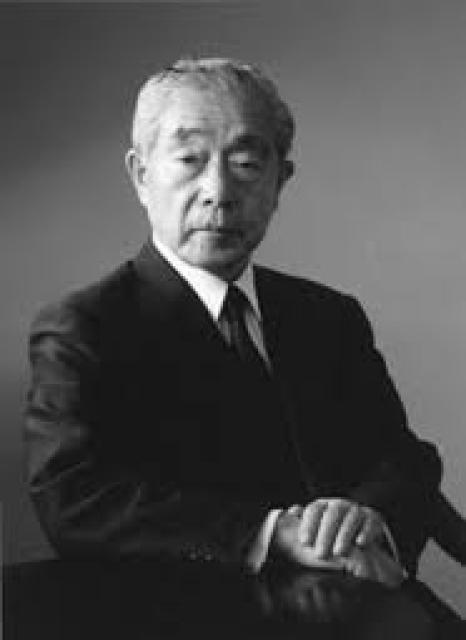
Kenichi Fukui
 Japan
Japan- Early Life and Education
- Research and Contributions
- Symmetry Principles and Nobel Prize
- Personal Life and Legacy
Early Life and Education
Kenichi Fukui, a prominent Japanese chemist, was born in Nara, Japan, to Hiei and Ryokichi Fukui. He had two younger brothers. Initially showing little interest in chemistry, Fukui's father persuaded him to study chemical engineering at the Kyoto Imperial University (presently Kyoto University). This decision proved crucial in his career path. He graduated in 1941.
Research and Contributions
After graduation, Fukui worked on synthetic fuel chemistry in a military laboratory for three years. In 1948, he earned his doctorate from Kyoto University and became an assistant professor. By 1951, he had become a full professor of physical chemistry at Kyoto University, where he remained for the duration of his career.
Fukui's initial research focused on various areas, including reaction modeling, inorganic salt-catalyzed organic synthesis, and the kinetics and catalysis of polymerization. His interests centered on submolecular phenomena in industrial chemical processes and their mathematical descriptions.
His major breakthrough came in the early 1950s when he proposed the concept of frontier orbitals. He discovered that only a small number of molecular orbitals, which he named frontier orbitals, significantly influenced reaction pathways. This concept states that a chemical reaction occurs when the highest occupied molecular orbital (HOMO) of one molecule interacts with the lowest unoccupied molecular orbital (LUMO) of another.
Symmetry Principles and Nobel Prize
Further developing this theory, Fukui realized that the geometric arrangement (symmetry) of frontier orbitals played a crucial role in chemical reactions. This idea was supported by independent work by Roald Hoffmann and R.B. Woodward.
Fukui's contributions to the field of chemistry earned him the 1981 Nobel Prize in Chemistry, which he shared with Hoffmann. The award recognized their independent development of theories on the course of chemical reactions. Their theories provided a framework for predicting the reactivity and selectivity of organic compounds.
Personal Life and Legacy
Fukui was a humble and amiable individual who enjoyed outdoor activities such as hiking, fishing, and golf. He married Tomoe Horie in 1947, and they had a son and a daughter.
Fukui's work revolutionized chemical experimentation and influenced various fields of chemistry. He received numerous accolades, including membership in the American Academy of Arts and Sciences, the European Academy of Arts, Sciences, and Humanities, and the International Academy of Quantum Molecular Science.
Kenichi Fukui's legacy continues to inspire chemists worldwide, and his theories remain fundamental to understanding the complexities of chemical reactions.





