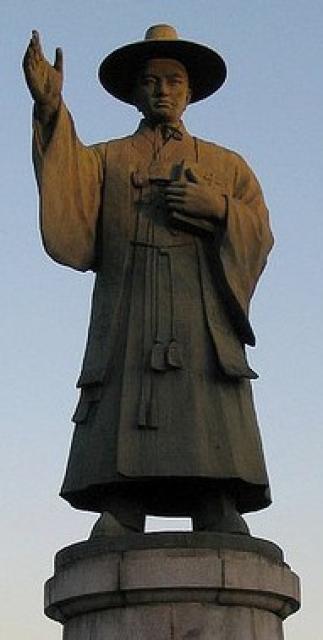
Kim Taegon Andrew
 South Korea
Saint Andrew Kim Taegon was the first Korean-born Catholic priest and one of the most revered figures in the history of Christianity in Korea. Born into a Catholic family at a time when the faith was suppressed by the Joseon state, he traveled abroad for seminary training, returned as a priest, and served his community for only a few months before his arrest and execution in 1846. His life became a defining story of the early Korean Catholic Church, which had grown for decades through the efforts of local believers before it had a native priest.
Early Life and Faith
Kim Taegon was born on August 21, 1821, in Solmoe, in what is now Dangjin, South Chungcheong Province, South Korea. The source record’s listed date of January 1 is not supported by the Catholic and historical accounts that identify his birthday as August 21. His family belonged to the Catholic community in Korea, where the religion had spread through Korean converts and lay leaders despite official restrictions. His father, Ignatius Kim Je-jun, was executed during the anti-Catholic persecution of 1839.
In 1836, at about fifteen years old, Kim was selected by the French missionary Pierre Maubant for priestly studies abroad. He traveled with two other Korean youths to Macao, then a Portuguese territory with a Catholic seminary, to study Latin and prepare for the priesthood. The distance from home and the dangers of travel reflected the obstacles facing Koreans who sought formal religious training at the time.
Training and Ordination
Kim’s formation took place across a politically unsettled region. After years of study and travel, he returned to Korea in 1845 and then made his way to Shanghai. On August 17 that year, Bishop Jean-Joseph Ferréol ordained him a priest. The ordination made Kim the first Korean native to receive Catholic priestly orders.
He soon returned to Joseon to serve Catholic communities and help foreign missionaries enter the country. His work involved careful, clandestine travel in a period when Catholic practice could bring arrest and severe punishment. Kim also prepared a map of Korea for the mission; a version based on his 1846 original is preserved in the collections of France’s National Library. The map offers a glimpse of his work beyond pastoral ministry, where geographical knowledge could help establish safer routes and communication.
Arrest and Martyrdom
In 1846, Kim helped explore a maritime route for bringing missionaries and correspondence into Korea. He was arrested that June while pursuing this work. Interrogated and imprisoned, he remained a target of official scrutiny because of his religious activities and connections with foreign clergy. On September 16, 1846, at the age of twenty-five, he was beheaded near Seoul at Saenamteo, a riverside execution ground associated with the persecution of Catholics.
His death was part of a wider wave of persecution against Korean Catholics. The community preserved his letters and memory, and the circumstances of his brief priestly service gave his story a special place in the Church’s account of its early history. Kim’s father had already died for the faith; the family’s experience became emblematic of the risks faced by converts in nineteenth-century Korea.
Canonization and Legacy
Pope John Paul II canonized Kim and 102 other Korean martyrs during his visit to South Korea on May 6, 1984. Kim is venerated as the patron saint of Korean clergy, and September 20 is observed in the Catholic calendar with Paul Chong Hasang and the Korean martyrs. Churches, schools, and cultural works in Korea commemorate his life, while the bicentenary of his birth in 2021 prompted renewed attention to his role in Korean religious history.
Kim’s legacy rests not only on his status as the first Korean-born priest, but also on the brief, consequential work he accomplished between ordination and arrest. His life connected Korea’s locally established Catholic community with the wider Church abroad, while his letters and map preserve a more personal record of the practical challenges he faced. He remains a central figure in the story of Korean Catholicism and its early martyrs.


