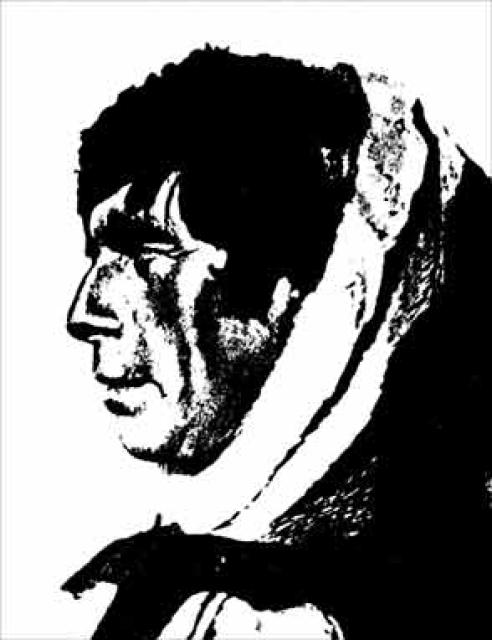
Knud Rasmussen
 Denmark
Biography of Knud Rasmussen
Knud Johan Victor Rasmussen (1879-1933) was a Danish ethnographer and explorer of Greenland and Arctic America. He was born on June 7, 1879, in Greenland, to a Danish Protestant pastor, Christian Rasmussen, and a Greenlandic woman named Louise Fleischer. Growing up, Knud spent his childhood surrounded by his Inuit peers and often visited their homes. As a young boy, he learned to paddle a kayak, handle a dog sled at the age of 7, and went hunting with adult Greenlanders by the age of 11. He was skilled in using a harpoon and could build kayaks, sleds, and snow igloos.
In 1895, Knud's father received a small parish in northern Denmark, and the family moved there to provide Knud with a better education. Initially, he struggled as he knew the Inuit language better than Danish, but he quickly learned Danish and excelled in his studies. In 1898, Knud graduated from high school and enrolled at the University of Copenhagen. He initially studied humanities, particularly philosophy, history, ethnography, and folklore. Later, he took courses in geography, geology, oceanography, zoology, and botany, which were related to field research. Knud was an avid reader of polar exploration literature.
In 1901, Knud spent his summer break in Lapland, where he learned about the lives of reindeer herders and the unique customs of the Sámi people. He later documented this research in his popular book "Lapland." The following year, Knud joined the Literary Expedition to Greenland, led by Danish journalist D. Møller-Erksen. The expedition aimed to explore Greenlandic life, record their stories and legends, and reach the northwest coast where Polar Inuit lived. Knud also accompanied the expedition as an ethnographer. They arrived in Greenland in June 1902 and explored the western coast, visiting several settlements and learning about the lives and customs of the Greenlandic people. Knud's knowledge of the Inuit language and culture proved valuable to the expedition's success.
After returning to Denmark, Knud spent several months processing the materials gathered from the expedition. In the summer of 1905, he returned to Greenland to study the possibilities of domesticating reindeer on the west coast. From 1906 to 1908, Knud embarked on his second expedition to Greenland, focusing on studying the spiritual culture of the Polar Inuit. During this time, he took responsibility for the welfare of the Polar Inuit, as the Danish government showed little interest in trading with the remote region.
With limited funding, Knud established a trading post named Tule on Cape York, at the edge of Melville Bay. The trading post bought fox furs and other products from local hunters and supplied them with weapons, ammunition, kerosene, flour, and other goods. Knud became the sole manager of the trading post until his death. In 1931, the Tule district was officially incorporated into Danish territory, and Knud became Denmark's official representative in Tule.
In 1912, Knud led the First Thule Expedition, aiming to map Melville Bay or explore the fjords in northern Greenland. The expedition successfully achieved both tasks. Knud made significant archaeological discoveries, uncovering ancient Inuit settlements and identifying the Tule culture. The expedition lasted four months and confirmed that Peary Land was part of Greenland, not a separate island.
In April 1916, Knud embarked on the Second Thule Expedition with the goal to explore the far north of Greenland. They faced challenging conditions and had to navigate through melting ice and treacherous terrain. The expedition successfully mapped the Melville Bay region and conducted archaeological research. They spent the winter at the Tule trading post and prepared for the next phase of the expedition.
On April 6, 1917, Knud and his team set out on their sleds, covering over 1,000 kilometers. They traversed the Humboldt Glacier and reached Washington Land. From May 3 to 6, they traveled along the frozen ocean, following the rugged coastline of northwest Greenland. The expedition faced numerous challenges, including thin ice and open leads, but they persevered. Knud and his team documented the landscape, geology, and climate of the region and made significant archaeological discoveries.
Knud Rasmussen's expeditions and research greatly contributed to the understanding and preservation of Greenlandic and Inuit culture. His works, including "The New People" and "Under the Northern Lights," brought attention to the lives and traditions of the Arctic peoples. Through his efforts, he became a respected figure among the Inuit and served as an advocate for their rights and well-being. Knud Rasmussen's legacy lives on as he is remembered as a pioneering explorer and ethnographer of the Arctic.



