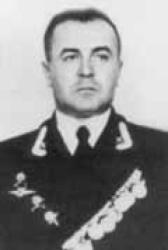
Konstantin Vishneveckiy
 Ukraine
- Biography of Konstantin Vishnevetsky
- Memories of a Friend
- - Lieutenant Vishnevetsky.
- Some of the listeners grumbled in dissatisfaction. Voices were heard:
- - Good.
- After telling me all this, Konstantin suddenly said:
- - Misha, do you see the enemy to the right of our course?
- - I'm going to attack! - Vishnevetsky's voice was heard again.
- When Vishnevetsky regained consciousness, he quietly said:
Biography of Konstantin Vishnevetsky
Konstantin Grigorievich Vishnevetsky was born in June 1914 in the village of Dmitrovka, Kazankovsky district, Nikolaev region, in a working-class family. He graduated from high school and a vocational school, where he worked as a lathe operator. In 1935, he joined the Red Army and graduated from the Odessa Military Flight School in 1937. He participated in the Soviet campaign in Western Belarus in 1939.
During the early days of the Great Patriotic War, Vishnevetsky courageously fought against the enemy on different fronts. He distinguished himself on April 17, 1943, during the battles for Myskhako. On that day, the 298th Fighter Aviation Regiment was assigned the task of providing air cover for the troops on the "Little Land." While patrolling the battlefield, one of the groups in the regiment spotted 20 enemy bombers escorted by 15 fighters and engaged them in combat. The aerial battle took place over the sea. Leading the group, Senior Lieutenant K. Vishnevetsky swiftly led his wingmen into the attack. In the first attack, he successfully shot down an enemy bomber, while two others were set on fire by Senior Lieutenant V. Drygin and his wingman. Enemy fighters rushed to the aid of the bombers, and the battle intensified. Sergeant V. Alexandrov was simultaneously attacked by three enemy fighters. The brave Komsomol member skillfully maneuvered his aircraft to evade the attacks. The pursuing German pilot failed to avoid an obstacle in time and crashed into a rock at high speed.
Vishnevetsky became one of the most distinguished pilots in the 298th Fighter Aviation Regiment, particularly in the battles on the Kuban. In one of the battles over the "Blue Line," he was severely wounded. Despite bleeding heavily, he skillfully landed his plane upon returning from the battle. By the summer of 1943, as the commander of the 229th Fighter Aviation Division in the 4th Air Army on the North Caucasus Front, Senior Lieutenant K. G. Vishnevetsky completed 123 combat sorties, shot down 10 enemy aircraft personally and 13 as part of a group. On August 24, 1943, for his courage and military valor displayed in battles against the enemy, he was awarded the title of Hero of the Soviet Union. Interestingly, on the same day, his 298th aviation regiment, for their successes in battles on the Kuban, was transformed into the 104th Guards.
Later, he continued his service as part of the 9th Guards Fighter Aviation Division under the command of A. I. Pokryshkin. In late September 1943, during a battle over the Moloch River, Konstantin Vishnevetsky shot down two enemy planes and was wounded again. Despite partially losing the mobility of his right hand, he was able to land his plane skillfully. After his injury, he was appointed as the assistant commander of the 9th Guards Fighter Aviation Division in the 6th Guards Fighter Aviation Corps, 2nd Air Army. However, he tragically died in a road accident in mid-January 1945 (according to other sources, on July 30, 1944) while traveling as a representative of the Air Force to the tank army command post Rybalko. Vishnevetsky was driving a trophy motorcycle in a convoy of vehicles when they were suddenly attacked by four FW-190 fighters. One of the trucks swerved off the road and struck Vishnevetsky, who was driving beside it at high speed.
It was a great loss for the entire division. The untimely death of this exceptional pilot and skilled commander on the eve of the complete victory tore him away from the ranks. He was buried in Lvov on the Hill of Glory. Vishnevetsky was awarded the Orders of Lenin, the Red Banner (three times), and the Patriotic War 1st Class. In the village of Kazanka, Nikolaev region, a monument was erected in his memory.
Memories of a Friend
We first met in 1937 when he joined my squadron as a pilot. He was young, slim, with a rosy complexion. He approached me, saluted smartly, and introduced himself:
- Lieutenant Vishnevetsky.
Due to bad weather, we couldn't test the flying skills of the newly arrived young pilots for a long time. But when a clear sunny day finally came after the rain and overcast skies, we prepared a pair flight. The regiment commander gathered the newcomers.
- While flying, you will be accompanied by an instructor. I am assigning Captain Berkaly, the squadron commander, to you for training.
Some of the listeners grumbled in dissatisfaction. Voices were heard:
- Are we being forced to learn again?- Did we waste our time in flight school?
The commander smiled:
- Oh, you young green ones. You don't understand anything. Do we doubt that you know how to fly? If we doubted, we wouldn't have allowed you near the planes. But we believe that a fighter pilot should not only know how to fly but be a virtuoso, a master of his craft. I would even call him an artist. Do you agree with me?
- Yes, of course... We understand, - Vishnevetsky shyly replied on behalf of everyone.
- Good.
Everyone who was free from duties gathered at the airfield. I also came to watch what my new subordinate was capable of. The plane rolled smoothly on the runway, gaining speed, and smoothly took off. Well, the takeoff was skillful. Mentally, I gave Vishnevetsky the first rating: "excellent."
The plane gained altitude, made a sweeping circle, and approached for landing. I had started to sympathize with my subordinate, worried about how he would land. Landing is the most challenging part of the flight, requiring precise calculations and good depth perception. But my fears were unfounded. The plane touched the ground with all three points. After a few more flights with the instructor and performing some advanced aerobatic maneuvers, Vishnevetsky was ready for solo flights. The last time he flew with me, the commander. He was satisfied. After the flight, he said:
- You know, Lieutenant, you have a valuable quality - quick reaction. You will be a good pilot.
Then Vishnevetsky flew in the same formation with me. He excelled in all training tasks, receiving "excellent" grades.
Unconsciously, we became closer. He often came to my house, and we talked for a long time over a cup of tea. But he became even dearer to me after one incident. We were sitting in the room, passionately discussing the recent flights. We got carried away to the point of forgetting about my son - a little mischief. He climbed onto the window and started playing. He would have fallen onto the street and been seriously injured if Vishnevetsky hadn't rushed to him and caught the child in mid-air.
From then on, we became even closer friends. We participated together in the Soviet campaign in Western Belarus. In one formation, we provided cover for our troops and flew to the Bialystok airfield.
But duty is duty! In May 1940, we had to part ways. I received a new assignment and left. And then the Great Patriotic War began. It brought immeasurable sorrow to the Soviet people, separating many loved ones. For me, the war helped me reunite with my friend. The regiment where I served as the deputy political commander participated in fierce battles and was then sent for rest. We received reinforcements and new planes. Then came intense training and preparation. And now, we can go back to battle. To test our readiness, a group of inspectors arrived from the Air Force headquarters. Among them was my friend, Senior Lieutenant Vishnevetsky.
Those who have experienced such reunions know their value. There was no end to the stories. Konstantin told me that the war caught him with his family where we served together. On the morning of June 22, he woke up to the dull hum of engines. It was dawn. The silhouettes of low-flying planes with swastikas on their wings were clearly visible against the pink sky. At first, it seemed like a terrible dream. But the subsequent bomb explosions left no doubt. As he hugged his frightened children and wife for the last time, Konstantin rushed to the airfield. He never saw his children again. They were buried on the same day by a Nazi bomb.
When Vishnevetsky rushed out onto the street, the houses were already burning. The enemy planes were coming in columns. Some crawled, others jumped to the side into the field. He finally made it to the airfield, crawling through the grass. His "Ishak" was unharmed, and Konstantin hurried into the cockpit. Along with the squadron commander, they taxied onto the runway. A bomb fell ahead. The shock wave turned the plane sharply, but fortunately, it didn't damage it.
And now, Vishnevetsky was in the air. Bombs were exploding below. It was hard to believe that the squadron commander's plane had caught fire and would no longer take off.
Konstantin was alone in the sky. Gaining altitude, he noticed a pair of Me-109s rapidly approaching him from below. Swiftly turning, he evaded the attack and counterattacked the enemy bomber Ju-88 from behind. He fired a long burst, and flames erupted from the right engine of the Junkers. The fire grew, and soon the bomber turned into a torch and fell.
On Vishnevetsky's left, a plane with red stars appeared. Konstantin recognized it as the commander's plane and joined it. Now they were attacking in pairs, and another enemy bomber crashed into the ground.
For a while, the sky cleared. Only a few I-16 fighters managed to take off. Landing at the main airfield was impossible, so the group went to the backup airfield.
Konstantin's heart ached with pain. He mourned the loss of his comrades, children, women, and old people who fell victim to the treacherous attack by the fascists. Several times in the following days, Vishnevetsky took off and participated in repelling enemy air attacks.
In the Smolensk area, during the assault on a mechanized column of the fascists, Konstantin saw a huge truck trying to escape into a field after jumping over a ditch. "You won't escape, parasite," the pilot thought and dove at the vehicle, pressing the trigger. When the truck caught fire, Konstantin pulled the plane out of the dive and started climbing. Suddenly, a powerful explosion shook the air. Vishnevetsky felt a sharp jolt. Something burned his right leg, and blood filled his boot. Soon, dizziness overcame him as he lost blood, and his vision darkened. Gathering his last strength, Vishnevetsky crossed the front line and landed the plane in a field on its fuselage.
For about five months, doctors worked to restore his health. Then he was assigned to a reserve squadron to train young pilots. He trained over 100 people for the front but was not allowed to go himself. Later, Vishnevetsky, as an excellent fighter pilot, was transferred to the Air Force inspection.
After telling me all this, Konstantin suddenly said:
- Now do whatever you want with me. I won't leave your regiment...This time, the command fulfilled Vishnevetsky's request. Once again, we found ourselves in the same fighting family...
We flew to the front, and the suffering of battle began. There was a lot of work to do. We had to cover ground troops, patrol the air, and escort bombers.
In March, the regiment, led by the commander, went with the bombers. Only Vishnevetsky and Second Lieutenant Mikhail Komenkov remained at the airfield. At that time, the command post received a message: "Enemy reconnaissance coming from the southeast, escorted by fighters." The message was immediately relayed to Vishnevetsky. Two fighters took off. From the ground, we could see the red-starred planes rapidly gaining altitude. Then we heard Vishnevetsky's voice over the radio:
- Misha, do you see the enemy to the right of our course?
- I see it, - Komenkov replied.Now, from the ground, we could also see three dots moving toward the airfield. The reconnaissance plane was in the lead, followed by the fighters.
The Germans clearly didn't see Vishnevetsky's pair, which approached from the direction of the sun. And our planes swooped in for engagement.
- I'm going to attack! - Vishnevetsky's voice was heard again.
Like crows scattering from a falcon, the enemy planes veered in different directions, but it was too late. One fighter, engulfed in flames, plummeted to the ground. While we watched it crash on the edge of the airfield, Vishnevetsky attacked the reconnaissance plane from behind. After a few shots, the Ju-88 started to smoke, flames appeared, and three people ejected from the burning plane. The pink parachutes hung above our heads.
As soon as the fighters returned, the mechanics painted the first stars on the fuselages of their planes. The political officer of the regiment immediately prepared a leaflet - the "lightning."
The next day, Vishnevetsky and Komenkov participated in the escort of bombers. During the suppression of an attack by enemy fighters, Konstantin shot down another Me-109.
By the end of April, six red stars adorned the fuselage of Vishnevetsky's plane, and he was awarded the Order of the Red Banner. Konstantin was promoted to captain and appointed as the commander of the best 1st Squadron in the regiment.
My friend was always characterized by incredible fearlessness. He never retreated and attacked the enemy, even when outnumbered. In late May, Vishnevetsky, leading a four-plane formation, took off to provide cover for the troops. After 15 minutes, we heard Vishnevetsky's voice over the radio:
- Engaged in combat with eight "Messers." New groups of Nazis are approaching...
After that, there was no more communication with Kostya. We could hear the commands of other pilots, but there were no voices from Vishnevetsky's group.
After a while, a smoking plane approached the airfield at full speed and landed straight on its fuselage without making a landing approach. The pilot, Senior Lieutenant Likhovid, was wounded. While the doctor bandaged him, he told us about the battle.
Approaching the cover area, they saw eight Me-109s. Vishnevetsky ordered them to attack, and he was the first to engage the enemy. One of the enemy fighters caught fire. But at that moment, other "Messers" attacked Likhovid and Krivobokov, who were providing cover for the commander. Likhovid was wounded, and his plane was hit. The pilot pulled the plane out of a steep dive near the ground and barely made it to the airfield.
As soon as Likhovid finished his story, everyone's attention was drawn to a plane approaching the airfield with its landing gear deployed. It had hit the ground without making an approach. When the plane struck the ground, the pilot didn't come out but rather fell out of the cockpit. It was Vishnevetsky. The doctor and medics ran to him.
The plane had rolled far beyond the runway. Its armored glass was shattered, and the cockpit was littered with fragments. The hydraulic brake lines and landing gear were damaged...
When Vishnevetsky regained consciousness, he quietly said:
- They killed Kolya Lobanov, the bastards.Tears ran down Konstantin's face. Everyone present knew that no one could experience as much in a lifetime as a pilot could in a few minutes.
Vishnevetsky's wounds turned out to be not serious. But his nervous system was severely shaken. He was sent to a sanatorium for two weeks, organized by the Air Force. During this time, he shared memories of his fallen friends and comrades. He mourned their loss and dreamed of revenge.
After his recovery, Vishnevetsky was assigned to the Air Force inspection. He continued to serve in the military and participate in combat sorties, carrying out his duties fearlessly and skillfully.
However, his life was tragically cut short. On one of his flights, his plane was hit by enemy fire, and he was shot down. Konstantin Vishnevetsky, an exceptional pilot and a brave fighter, gave his life for his country.
His memory will forever remain in the hearts of his comrades and all those who knew him.