
Kurt Wenner
 USA
USABiography of Kurt Wenner
Kurt Wenner is an American artist of international renown, best known as the inventor of the technique of three-dimensional street art - flat drawings on pavements and sidewalks that, when viewed from a certain angle, appear to have realistic depth. He began drawing commissions at the age of 16, and by the time he was 17, he was earning enough from these commissions to support himself.
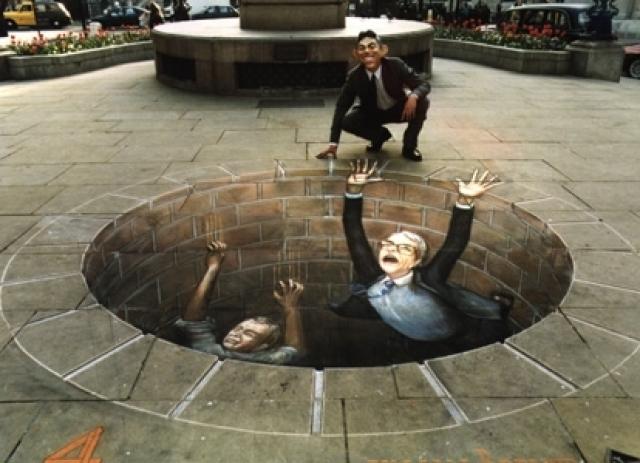
Wenner studied at the Rhode Island School of Design and the Art Center College of Design, and later worked at NASA. Surprisingly, his artistic talents found a place in the space industry, where he excelled as an illustrator. His highly detailed and vivid paintings of space projects and otherworldly landscapes were highly regarded.
In 1982, Wenner left NASA and returned to focus on his art. He created his first three-dimensional painting on the pavement outside the Santa Barbara Museum of Art. Shortly after, he organized the first street artist festival in the United States, called 'Old Mission', which took place in Santa Barbara, California. The festival continues to this day and is just one of the many successful projects organized by Wenner.
Wenner also dedicated ten years to teaching his unique 'Pavement Art Mastery Course', where he taught over 100,000 students of all skill levels how to create chalk and pastel drawings. In recognition of these courses, Wenner was awarded the Kennedy Center Medallion.
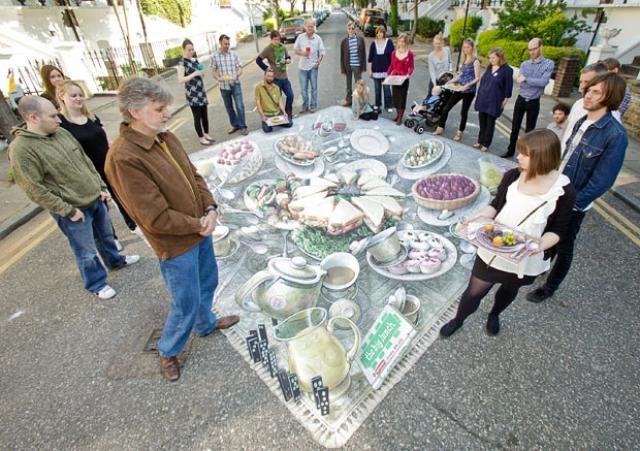
While Wenner is widely known for his three-dimensional artwork, which revolutionized street art, he has also influenced many other artists. Some of his most successful followers include Julian Beever, Manfred Stader, and Edgar Muller. Creating these three-dimensional paintings requires not only exceptional artistic abilities but also a deep understanding of geometry to accurately calculate perspective lines. However, there are now software programs available that simplify these calculations.
Wenner's paintings are not only impressive in their three-dimensionality but also tell unique stories and challenge contemporary artists who mistakenly believe that classicism is a thing of the past. His street art serves as a demonstration of how the techniques of classicism can be used to create new forms of artistic expression.
Although Wenner was actively involved in various festivals in the past, he has now returned to his roots in fine art and continues to create masterpieces on commission. His talent extends to various styles, including painting, sculpture, and frescoes. Additionally, his works are widely used in advertising. One of Wenner's recent achievements is his book, 'Asphalt Renaissance', which chronicles the history of pavement and sidewalk paintings and his role in reviving this forgotten craft.


