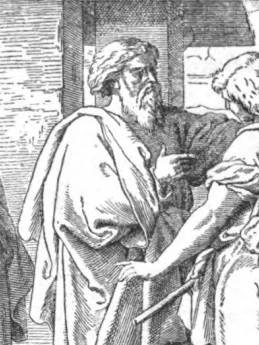
Laban
Laban is a prominent figure in the Book of Genesis, remembered as the brother of Rebekah and the uncle, employer, and father-in-law of Jacob. His household becomes the setting for a long family story of marriage, labor, rivalry, and escape. Laban is portrayed as shrewd and protective of his own interests, but also as a powerful relative whose decisions shape the lives of his daughters and Jacob’s growing family.
Brother of Rebekah
Genesis first introduces Laban when Abraham’s servant arrives in Aram-naharaim seeking a wife for Isaac. Rebekah agrees to travel with the servant, and Laban joins their father Bethuel in approving the marriage. The narrative gives Laban an active voice in arranging his sister’s future, reflecting the authority that male relatives held in the family’s affairs.
Years later, Rebekah sends her son Jacob to stay with Laban after Jacob’s conflict with his brother Esau. At the well, Jacob meets Laban’s younger daughter Rachel and falls in love with her. Laban welcomes his nephew, but the relationship soon becomes a negotiation over work, marriage, and family obligations.
Jacob’s Marriages and Service
Jacob agrees to work seven years for Rachel’s hand. When the time comes for the wedding, Laban gives him his elder daughter Leah instead. He explains that local custom requires the elder daughter to marry first, then offers Rachel to Jacob in exchange for another seven years of service. Jacob accepts and marries both sisters, setting up years of tension between Leah and Rachel as they compete for affection and children.
Laban’s household grows through the births of sons and daughters to Leah, Rachel, and their servants. The story presents Laban as a hard bargainer who repeatedly adjusts Jacob’s wages, while Jacob also seeks to improve his own position through a selective breeding arrangement with the flocks. Their dealings become a contest of strategy, with each man attempting to gain advantage.
The Departure from Aram
After many years, Jacob decides to leave with his family and animals. Laban is away shearing sheep when Jacob departs, and Rachel secretly takes her father’s household gods. Laban pursues the family and confronts Jacob, accusing him of leaving without permission and searching for the missing idols. Jacob denies knowing that Rachel has taken them. She hides them among her belongings, and Laban does not find them.
The confrontation also reveals the daughters’ grievances. Leah and Rachel complain that their father has treated them like outsiders and used up the wealth associated with their marriages. The episode presents the family’s separation as both a dispute over property and an attempt by Jacob’s household to break free from Laban’s control.
Laban and Jacob eventually make a covenant at Gilead, marking a boundary between their households and promising not to harm one another. Laban returns home, and Jacob continues toward Canaan. The agreement closes a relationship that began with kinship and hospitality but became strained through years of mistrust and unequal bargaining.
Character and Legacy
Laban’s story is preserved in Genesis and belongs to the biblical ancestral narrative; independent historical evidence for him is not available. Within that narrative, he is neither a simple villain nor an uncomplicated benefactor. He offers Jacob refuge and work, arranges marriages for his daughters, and provides a home for the expanding family, yet his repeated changes to the terms of their arrangement leave Jacob feeling exploited.
The two men mirror one another in their use of cunning. Jacob had earlier deceived his father and brother, while Laban deceives him over the wedding and wages. Their rivalry becomes a story about kinship under pressure, the cost of ambition, and the struggle to establish a household of one’s own. Through his connections to Rebekah, Leah, Rachel, and Jacob, Laban occupies a central place in the family histories that Genesis traces into the story of Israel.