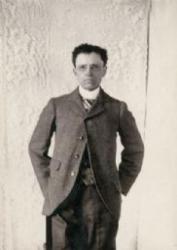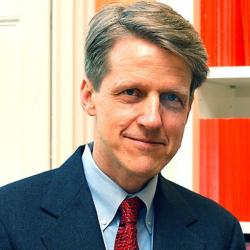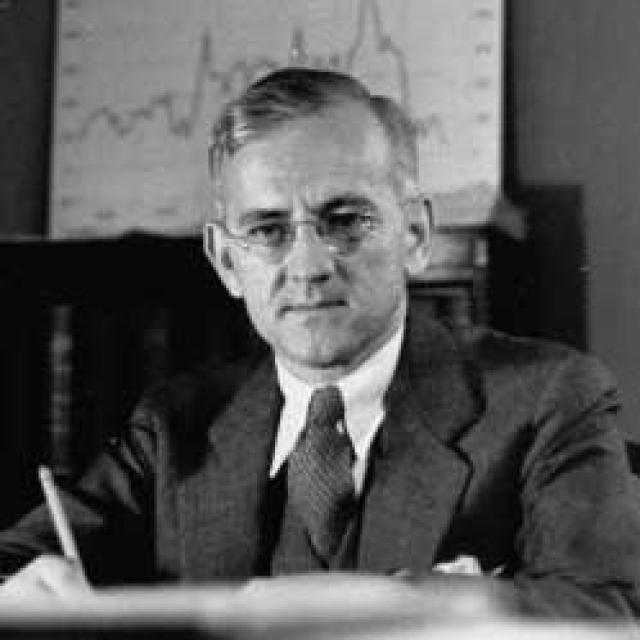
Lauchlin Currie
 USA
USA- Biography of Lauchlin Currie
- Early Life and Education
- Career and Contributions
- Accusations and Later Life
Biography of Lauchlin Currie
Lauchlin Currie was an American economist of Canadian descent. He was known not only for his economic activities, but also for his involvement in a grand spy scandal, which indicated that he may have been a Soviet agent.
Early Life and Education
Currie was born to Lauchlin Bernard Currie, a shipping fleet dispatcher, and his wife Alice Eisenhauer Currie, a school teacher. Sadly, his father passed away when he was only four years old. Currie and his mother moved to Bridgewater, where he primarily received his education.
In 1922, Currie moved to the United Kingdom and enrolled at the London School of Economics. His mentors included Edwin Cannan, Hugh Dalton, A. L. Bowley, and Harold Laski. He later attended Harvard University, where he was greatly influenced by Allyn Abbott Young, the president of the American Economic Association. In 1931, Currie obtained his doctorate in economics, focusing his dissertation on the theory of banking.
Career and Contributions
Currie worked at Harvard until 1934, during which time he served as an assistant to Ralph Hawtrey, John H. Williams, and Joseph Schumpeter. One of Currie's notable students was Paul Sweezy. In 1934, Currie developed his first income velocity and cash balance system for the United States. His research led him to conclude that the government was to blame for several irrational measures taken during challenging times. That same year, Currie became a naturalized U.S. citizen and joined the "freshman brain trust" organized by Jacob Viner at the U.S. Treasury. This trust aimed to develop an ideal currency system for the United States and proposed a plan for a reserve banking system to strengthen overall banking stability.
In 1934, Marriner Eccles transferred from the Treasury to the Federal Reserve Board and took Currie as his personal assistant. Currie is credited with creating the prototype of the Banking Act of 1935, which significantly reorganized and strengthened the Federal Reserve. In July 1939, Currie began advising the White House on taxation, social security, and accelerated production. In January 1941, he embarked on a diplomatic and economic mission to China, whereupon his return, he recommended including China in the lend-lease program.
Accusations and Later Life
After the war, Currie was accused of "losing" China. In 1939, Whittaker Chambers, a defector from the communist camp, referred to Currie as a Soviet agent. His claims were later confirmed by Elizabeth Bentley, another Soviet accomplice. Bentley named Currie and Harry Dexter White as members of the so-called "Silvermaster ring." White and Currie were summoned to testify before the House Committee on Un-American Activities. White passed away three days later due to heart problems, but Currie did not face any punishment at that time. It was not until 1954, when his passport renewal was unexpectedly denied, that Currie faced consequences. By that time, he had already relocated to Columbia. Currie briefly shifted his focus to cattle farming in 1954, but soon the Colombian government sought his advice again. Currie continued to provide consultancy to the Colombian government until his death.
Lauchlin Currie passed away on December 23, 1993, from a heart attack.