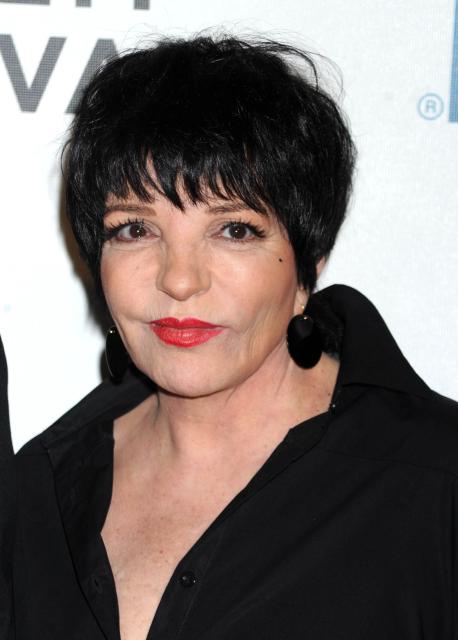
Liza Minnelli
 USA
USALiza Minnelli: A Biography
Liza Minnelli, an American actress and singer, was born on November 8, 1964. On that day, the packed auditorium of London's Palladium fell silent and literally stopped breathing. No one expected that eighteen-year-old Liza Minnelli would so clearly and unequivocally overshadow her famous mother, Judy Garland. The audience had gathered to see Garland, but Liza's powerful presence and sensual voice captivated them like champagne, and they shifted their allegiance. Garland's heartfelt lyrics seemed feeble and faded against Liza's vibrant and energetic solos. The reserved and seemingly uninterested British audience couldn't resist joining in and singing along with Liza. It was a dramatic turning point, as Liza finally broke free from her mother's shadow and asserted her own identity on stage. She triumphantly performed the famous song "Who Now Regrets" as if accusing Garland. The rivalry between mother and daughter, initially thought to be a well-rehearsed act, began to intensify before the eyes of hundreds of spectators. The stage crackled with tension as personal issues were laid bare. Liza rejoiced, finally reclaiming her right to be herself, not just "Judy Garland's daughter." She relished the fact that she was nothing like her mother. This fact pleased her more than anything else.

Since the age of twelve, Liza had been constantly complimented on her resemblance to her mother. She graciously accepted the compliments, but before bed, she would pray to God, asking for a good character, one that didn't resemble her mother's. She didn't want to be like her, to torment everyone, shout at them, and be sick like her. From the outside, her childhood seemed enviable. It was no wonder since Liza was born into the glamorous world of celebrity idols. She befriended the children of other movie stars, such as Dean Martin, Oscar Levant, and Lana Turner. Her father, Vincente Minnelli, a successful Hollywood director, often took her to the movie studio, where playing in the grand MGM soundstages was an incomparable pleasure. Their large mansion in the suburbs of Los Angeles was a hub of entertainment, hosting home performances, circuses, magicians, and even a private train guarded by police. Her parents competed with each other to provide Liza with the most extravagant amusements. When Liza entered a small restaurant with her mother, even in the most remote provinces, she knew that within three minutes a crowd would gather around them, begging Garland for an autograph, even on a lunch napkin. Americans adored Judy Garland, who once played Dorothy in "The Wizard of Oz," and they knew the movie by heart. In addition, Garland was a well-known singer. During her performances, little Liza would often run onto the most famous stages in the world to dance and spin in the spotlight.
The fairy tale ended when Liza's parents divorced. Their marriage was never solid, but Vincente Minnelli, being a wise man, always tried to shield Liza from things that she, God forbid, shouldn't see or know. Now that Vincente was no longer around, Judy's life spiraled out of control. Certainly, the capricious and erratic Mrs. Garland could occasionally be kind and tender. During the preparation for Christmas, the children - Liza, her half-sister, and half-brother from another marriage - would create Christmas scenes with their mother. Judy would teach them to dance and sing songs. But these idyllic moments were rare and always ended the same way - Judy couldn't handle it and fell into depression. Then came the piles of pills, gallons of alcohol, and periodic stays in various clinics, which temporarily improved the situation until the next breakdown. Liza became like a confessor to her mother, or rather a garbage can for her emotional debris. Judy would openly share the most unsightly stories from her tumultuous life with her daughter, and it would make her feel better. In these confessions, Liza had two tasks: to listen attentively and sympathize with her mother's problems. The frightened girl listened and sympathized obediently, even though she barely understood what her mother was talking about.
Even worse things happened. Every six months, Judy, once again swearing off drugs and going through withdrawal, would attempt suicide. Liza will never forget the first time it happened. She was ten years old. She and her friend sat in the living room, watching TV when Judy walked in, wringing her hands and loudly crying that her life had been a failure and that she had no choice but to end it. Then she quickly left and locked herself in the bathroom. The children ran after her. Terrified, Liza pounded on the door with trembling hands and cried out, "Mommy, please don't kill yourself! Mommy! Open the door! I'm scared alone!" "Mommy" did not respond. When the butler arrived and broke down the door, they couldn't believe their eyes: there was Judy, sitting on the edge of the bathtub, smiling, as she dumped a bottle of aspirin into the toilet. Such stories repeated frequently. Among Judy's countless suicide attempts, not all of them were staged. In addition to the panic of the possibility that her mother might harm herself, Liza and her siblings were haunted by the constant fear that she might simply abandon them. Judy never stopped telling her son and daughters that they were a burden to her. Garland didn't hesitate to kick the children out of the hotel room into the corridor or lock them inside for the whole day while she went about her business. As the oldest, it was up to Liza to comfort her younger siblings and assure them that their mother loved them and would soon return (although Liza herself had no confidence in this).
Is it surprising that shortly after turning fifteen, Liza rushed to leave home and enrolled in the New York School of Performing Arts? She was driven not only by the desire to escape her mother but also by the realization that Judy only seemed happy when she sang or acted in movies. Therefore, the stage seemed like a magical place to Liza, where people could feel comfortable and forget all their troubles.
The day of the premiere of her first musical, "Best Foot Forward," in a small theater on the outskirts of Broadway, became both great and terrible for Liza. Tickets sold out instantly, and just before the start of the show, Liza realized why: from behind the scenes, she saw Judy Garland herself, accompanied by a crowd of reporters, photographers, and publicists, enter the small theater. Dressed in a luxurious white silk dress with a rose on her chest and a diamond tiara in her hair, she graciously nodded to those present and took her seat. Meanwhile, behind the scenes, her daughter was in tears and swore she would never go on stage. "I asked her not to come, at least not to the premiere! Now I'll definitely be a joke next to her stupid dress..." Liza sobbed on the shoulder of the show's producer, Bob Smith. He was taken aback, as he couldn't not invite Judy and give up such a powerful tool for promoting the show. Liza's debut unfolded as she feared: the critics unanimously called her a "carbon copy of Judy Garland."
"Of course, it is evident that she is the daughter of the magnificent Judy Garland," Liza read with a bitter sigh to her friend Tana Everett Walter Kerr's review, New York's most influential theater critic. "In her voice, we hear the familiar husky tremolo and the muted laughter after each line." "No, I won't let this stand!" Liza suddenly erupted. She somehow obtained Walter Kerr's phone number and called him in one breath, exclaiming, "You know nothing about musicals or actresses! You have no eyes or ears!" Kerr, not understanding what was happening, surprisedly said, "My goodness, you're just like Judy! She could have called like this too!" Liza was infuriated, and in her anger, she hung up the phone.
In 1966, Liza Minnelli was awarded a Tony as the best young actress in a musical. Producers now fought over Minnelli because her name guaranteed full box office receipts. Gradually, people began talking about Minnelli as one of Manhattan's landmarks. However, they didn't just mean her acting talent. All-knowing reporters dutifully informed the public that after evening performances, actress Liza Minnelli would undoubtedly lean on a supportive male shoulder. Liza seemed not to care who it was: her musical director Fred Ebb, composer John Kander, school friend Marvin Hamlisch, or just a stranger who winked at her after a show. "Anyone who looks at Miss Minnelli kindly and compliments her new outfit (usually too bright) has a chance of ending up in her bed on the same evening," the press wrote. This was true, but only partially. In reality, Liza simply suffered - and was deeply embarrassed by it - from a pathological fear of loneliness. She couldn't be alone at home for more than fifteen minutes, tormented by various phobias and premonitions. She always felt that something terrible was about to happen, either to her (right now!) or to someone close to her. She spent her days at the theater, and in the evenings, she urgently needed to find someone willing to stay with her until morning. If there was no company, Liza preferred to spend the night at a disco or a bar - anywhere but in an empty apartment alone with herself.
It is no wonder that Judy Garland, who always considered herself a virtuous puritan, was not pleased to read in the newspapers that her daughter, as soon as she escaped her parental guardianship, indulged in all sorts of vices. Did Judy link Liza's "frivolous" behavior to echoes of her childhood cries of "Mommy, don't leave! (or the more sinister version: "Mommy, don't kill yourself!")? Unlikely. Judy didn't attach much importance to such memories and had long forgotten about such nonsense. Her concerned maternal instinct simply told her that it was time to "save" her daughter. And Judy wouldn't be Judy if she didn't do it in a very peculiar way.
A few days later, she "accidentally" introduced her daughter to her young friend, Australian musician Peter Allen. Garland had recently helped him gain fame in Europe and America - Peter had beautiful eyes and a way with compliments. In general, Garland liked him. Motivated by a complex mix of grief, jealousy, and concern for her daughter, Judy executed a brilliant maneuver that resulted in Peter and Liza finding each other in the whirlwind of New York's bohemian world.
It was easy to deceive the trusting and naive Liza. All Peter had to do was tenderly and devotedly look into her eyes and, during shared meals, discreetly stroke her hand under the table. One day, while stroking her hand, Peter secretly put a diamond ring on her pinky finger and whispered in her ear, "If you agree to marry me, I will do everything to make you happy." Liza was ecstatic - her long-standing dream of a reliable male shoulder was finally coming true. She would no longer have to fear every night that no one would stay with her and hide this shameful fear from everyone. Besides, her mother's words sounded so convincing: "Liza, this is your destiny. He is beautiful and very talented!" Vincente Minnelli, who came to visit his daughter from Paris where he was shooting, was sad and silent. "At least she'll stop wandering," Judy suggested to him, although Vincente did not share her joy.
The official engagement was celebrated in London at the famous bohemian nightclub, Ad-Lib, owned by the notorious Jackie Collins. Liza and Peter found themselves in a cult-like company of bohemian elites - the club's regulars included the Beatles, Rudolf Nureyev, and Margot Fonteyn. Liza, in her extravagant yellow suit with shoes adorned with crimson sequins, immediately attracted everyone's attention. Dancing with everyone and seductively batting her eyes at George Harrison, Liza discreetly watched to see if her fiancé was jealous. Meanwhile, he was nowhere to be seen. He disappeared almost immediately after they entered. In the end, an upset Liza had no choice but to dive under the invitingly open half-cloak of George Harrison and let him lead her away in an unknown direction.
Liza and Peter preferred to never mention this incident. The wedding took place, and the newlyweds settled in an expensive apartment on 57th Street in Manhattan, trying to portray a happy married life. Liza firmly and unconditionally decided that since she was now a wife, she would not cheat! Otherwise, she would surely end up like her mother, constantly moving from one husband to another. Keeping this promise proved to be terribly difficult. Minnelli worked in musicals and performed in cabaret shows, while Peter traveled across the country, appearing in Toronto, Miami, Las Vegas, or obediently following Judy's tour as a musical "addition" to her concerts. On the days and weeks when Peter was absent, Liza spent her nights in conversations with her new friend, fashionable New York fashion designer Roy Halston Frowick. They would simply chat innocently - women interested Halston only as conversation partners. If he happened to be busy, the neurotic Liza immediately called her father in Los Angeles and kept him on the phone until dawn. Going out alone at night to bars and nightclubs, as she had done before, was strictly forbidden for Liza - she knew all too well where it usually led her.
By 1969, even the most "impenetrable" critics recognized Minnelli's uniqueness and talent. She was nominated for an Oscar for her role in "The Sterile Cuckoo." Everyone admired the scene in the telephone booth, saying it deserved any award. In oversized horn-rimmed glasses, with her nose wrinkled in suffering, laughing and crying at the same time, Minnelli's character listened and couldn't believe her ears - her romance was over? It couldn't be!