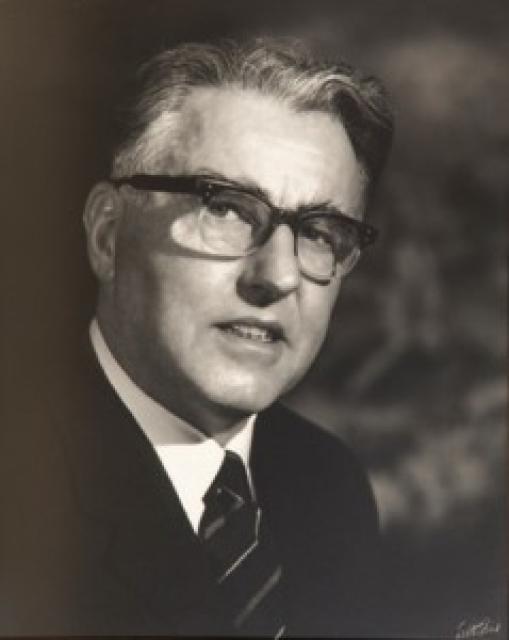
Louis Harold Gray
 Great Britain
- Lewis Harold Gray: A Pioneer in Radiobiology
- Early Career and Research
- Contributions to Radiobiology
- Recognition and Legacy
Lewis Harold Gray: A Pioneer in Radiobiology
Lewis Harold Gray was an English physicist who made significant contributions to the field of radiation effects on biological organisms. He is considered one of the pioneers of radiobiology, and his work led to the establishment of the unit of absorbed radiation dose, which was later named "gray" in the International System of Units (SI) in his honor.
Early Career and Research
In 1933, Gray started working at Mount Vernon Hospital in London, where he began his research on the effects of radiation. In 1936, he developed the Bragg-Gray principle, which formed the basis of a method for measuring the absorption of gamma radiation by materials. The following year, Gray created one of the first neutron generators at Mount Vernon Hospital.
Contributions to Radiobiology
In 1940, Gray conducted comparative biological studies on the effectiveness of different types of radiation, leading to the introduction of the unit of absorbed radiation dose. His research in 1952 focused on the effects of radiation on bacteria and tumor cells. As a result of his groundbreaking work, the Gray Laboratory was established at Mount Vernon Hospital in 1953.
Recognition and Legacy
In addition to his scientific achievements, Gray served as the Vice-President of the International Commission on Radiation Units and Measurements (ICRU) from 1956 to 1962. He was elected a fellow of the Royal Society in 1961, further highlighting his significant contributions to the field of radiobiology.
Today, Lewis Harold Gray is remembered as a pioneering physicist whose research paved the way for understanding the effects of radiation on biological organisms. His name lives on through the Gray unit, which continues to be used worldwide in radiation measurement and research.