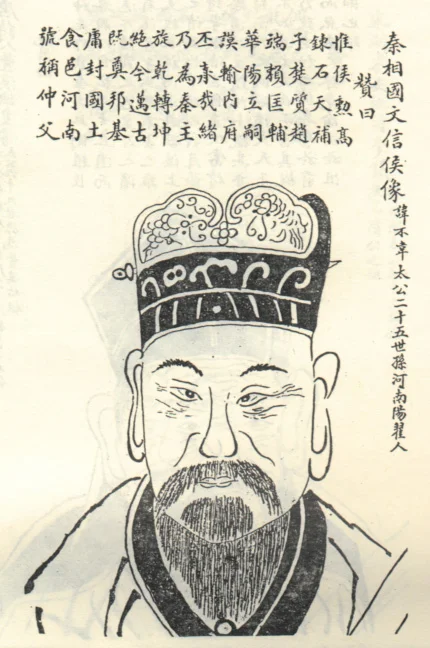
Lü Buwei
Lü Buwei rose from commercial success to the highest ranks of the Qin state, becoming a powerful minister at the moment when Qin was poised to unite China. He is remembered both for the political maneuvering that helped place the future First Emperor on the throne and for sponsoring the *Lüshi chunqiu*, a sweeping collection of philosophical and practical writings. His career ended in disgrace, but the work associated with his name outlasted the court intrigues that brought him down.
From merchant to court power
Lü Buwei was born around 291 BCE, though details of his early life are uncertain. Later accounts describe him as a wealthy traveling merchant from the state of Wey. During his travels, he encountered Prince Yiren, a Qin royal hostage living in the state of Zhao. Recognizing a political opportunity, Lü is said to have helped the prince gain support at the Qin court and eventually return home.
Yiren became King Zhuangxiang of Qin in 249 BCE and appointed Lü Buwei to high office. The new king’s reign was brief: he died in 247 BCE, leaving his young son Zheng as heir. Lü became regent and chancellor, wielding extensive influence over the affairs of the state while the boy grew into his role as ruler.
A later and sensational story, preserved by the historian Sima Qian, alleged that Zheng was Lü’s biological son, born to a concubine Lü had given to Yiren. The story has never been securely verified and may reflect political rumor or an attempt to undermine the First Emperor’s legitimacy. It should not be treated as established fact.
Chancellor of Qin
As chancellor, Lü Buwei presided over a court competing for power during the final decades of the Warring States period. Qin’s military and administrative strength was growing, and its rulers pursued the conquest of rival states. Lü’s influence placed him near the center of this transformation, though it is difficult to separate his own role from the work of other officials, generals, and court factions.
His household was renowned for its scale. Ancient accounts describe him as maintaining thousands of retainers, including scholars and specialists from different intellectual traditions. Such households were both instruments of political prestige and centers of literary production. In Lü’s case, they helped create a work that aimed to gather knowledge useful to rulers and officials.
The *Lüshi chunqiu*
Around 239 BCE, Lü sponsored the compilation of the *Lüshi chunqiu*, often translated as *The Spring and Autumn Annals of Master Lü*. It is a vast compendium organized into sections on seasons, treatises, and discussions of historical examples. Its subjects include rulership, ethics, warfare, agriculture, music, human nature, and the order of the cosmos.
The compilation draws on a range of intellectual traditions rather than presenting a single tightly unified doctrine. It combines ideas associated with Confucian, Daoist, Mohist, and other currents of thought. The project reflects an ambition to assemble practical and philosophical knowledge into a guide for governing an increasingly unified realm. Although later tradition attributes the work to Lü, it was produced by a team of scholars under his patronage.
The work’s preface includes a famous challenge: Lü is said to have offered a reward to anyone who could identify a word that should be changed. Whether the episode is fully historical or polished into a memorable legend, it conveys the text’s reputation for careful editing and completeness.
Fall from power and death
Lü’s position became precarious as King Zheng asserted personal authority. Court tensions deepened after accusations involving Lao Ai, a court favorite connected with the queen dowager, and a failed revolt in 238 BCE. Lü was implicated through his earlier association with the circle and lost office in 237 BCE. He was ordered to leave the Qin capital and retire to his fief.
The king later sent a letter warning that Lü’s political influence remained a danger. According to the *Shiji*, Lü Buwei died by suicide in 235 BCE, apparently by taking poison. The account is dramatic and written generations later, so the precise circumstances cannot be independently confirmed. After his death, his followers were dispersed and his household’s political influence ended.
Legacy
Lü Buwei’s life joined commerce, political ambition, and intellectual patronage. He helped a royal claimant secure the Qin throne, governed as regent during the future emperor’s youth, and assembled scholars whose work preserved a broad record of late Warring States thought. The uncertain story of his alleged paternity has often overshadowed these achievements, but it remains only one strand in a biography shaped largely by later historical narratives.
The *Lüshi chunqiu* remains his most durable legacy. It offers a window onto a world in which rival states were nearing unification and thinkers debated what made government effective. Lü’s political fortunes collapsed before that unification was complete, yet the compendium he sponsored survived as one of the era’s major intellectual works.