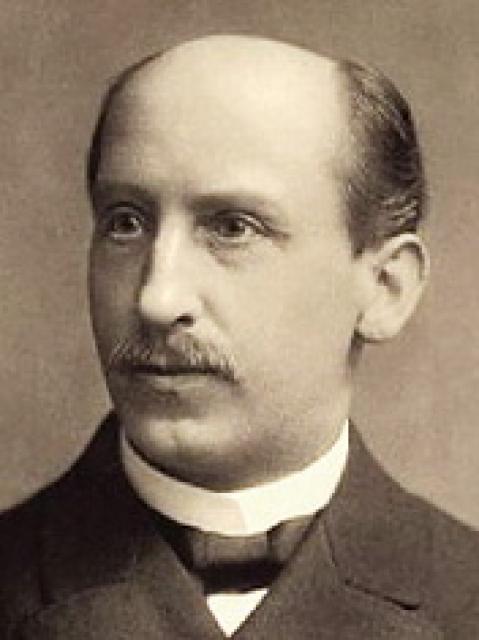
Ludwig Rainer Claisen
 Germany
- Early Life and Education
- Academic Career
- Professorship at Kiel and Berlin
- Private Research Laboratory
- Contributions to Organic Chemistry
- Claisen Condensation
- Claisen Flask
- Tautomerism Studies
- Claisen Rearrangement
- Organic Syntheses
Early Life and Education
Born in Germany, Ludwig Claisen pursued his studies at the University of Bonn under August Kekulé and Friedrich Wöhler. He received his doctorate in 1875 and became Kekulé's assistant.
Academic Career
Claisen held teaching positions at the University of Bonn (1875-1882), the University of Manchester (1882-1885), and the University of Munich (1886-1890) under Adolf von Baeyer. In 1890, he became a professor at the Technical University of Aachen.
Professorship at Kiel and Berlin
From 1897, Claisen served as a professor at the University of Kiel. In 1904, he moved to the University of Berlin, where he collaborated with Emil Fischer.
Private Research Laboratory
In 1907, Claisen established his own private laboratory in Bad Godesberg, where he continued his research.
Contributions to Organic Chemistry
Claisen's work focused on developing methods for organic synthesis, acylation of carbonyl compounds, and the study of isomerism and tautomerism.
Claisen Condensation
In 1887, Claisen discovered the disproportionation of aldehydes to form esters. This reaction, known as the Claisen condensation, is widely used in organic synthesis.
Claisen Flask
Claisen designed a special flask for vacuum distillation in 1893. This flask is still commonly used in laboratory experiments.
Tautomerism Studies
Claisen's investigations into the tautomeric transformations of acetoacetic ester (keto-enol tautomerism) contributed significantly to the understanding of organic chemistry.
Claisen Rearrangement
In 1912, Claisen discovered the rearrangement of allyl phenyl ethers to form allyl-substituted phenols. This reaction is known as the Claisen rearrangement.
Organic Syntheses
Claisen achieved numerous organic syntheses, including the synthesis of isatin, derivatives of pyrazole and isoxazole, and oxymethylene derivatives of acetoacetic and malonic esters.


