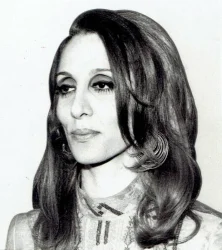
Lys Assia
- From Dancer to Singer
- Eurovision’s First Champion
- Private Life and Public Persona
- A Place in Eurovision History
Lys Assia became the first winner of the Eurovision Song Contest, but her career was already well established before the contest began. A Swiss performer who moved from dance to singing, she won audiences across German-speaking Europe with the song “O mein Papa” before taking “Refrain” to victory at Eurovision’s inaugural edition in 1956. Her poised stage presence and long connection to the competition made her one of its enduring figures.
From Dancer to Singer
Born Rosa Mina Schärer on 3 March 1924 in Rupperswil, Switzerland, she trained as a dancer and began performing on stage at a young age. In the early 1940s, she moved into singing after stepping in for an absent vocalist. The switch brought her to radio and recording, and she signed her first record contract in 1943.
During the war years, Assia performed in revue shows in France and continued building her career across Europe. Her breakthrough came with “Eine weiße Hochzeitskutsche” in 1946, followed by tours and radio appearances. In 1950, she recorded “O mein Papa,” a song from the Swiss musical *Der schwarze Hecht* by Paul Burkhard. It became an international hit and established her as a major star in the German-language Schlager tradition.
Assia also appeared as an actress and worked across several musical styles and languages. Her clear, expressive voice and polished stage manner suited both sentimental songs and the more formal, orchestra-backed performances that were common on postwar European radio and television.
Eurovision’s First Champion
In May 1956, Assia represented Switzerland at the first Eurovision Song Contest, held in Lugano. The inaugural event had a format unlike the modern competition: each of the seven participating countries submitted two songs, accompanied by a live orchestra. Assia performed both Swiss entries, “Das Alte Karussell” in German and “Refrain” in French. “Refrain,” written by Géo Voumard and Émile Gardaz, won the contest and made her Eurovision’s first champion.
She returned for Switzerland in 1957 with “L’enfant que j’étais,” placing eighth, and in 1958 with “Giorgio,” which finished second. Eurovision became a lasting part of her public identity. In later years she appeared at the contest as a guest, helped present trophies, and was welcomed as a living link to its earliest history.
Assia remained engaged with the competition well into her later life. In 2012, at age 88, she entered Switzerland’s national selection with “All in Your Head,” a song featuring the hip-hop group New Jack. The entry did not reach Eurovision, but it showed her willingness to revisit the stage on new terms.
Private Life and Public Persona
Assia married hotelier Oscar Pedersen in 1963, and the couple lived and worked in several countries. She maintained an international lifestyle while continuing to perform and make public appearances. Her career stretched across changing eras of popular music, from live radio and dance halls to televised song contests and online fan communities.
Onstage, she was often described as elegant and gracious. Her reputation as “the first lady of Eurovision” came not only from her 1956 victory but also from her continued presence at later editions, where she represented the contest’s origins to new generations of viewers.
A Place in Eurovision History
Lys Assia died in Zurich on 24 March 2018, aged 94. She left behind a long recording and performing career, with “O mein Papa” and “Refrain” remaining her best-known songs.
Her victory in Lugano helped give Eurovision a memorable beginning. The contest would grow into an international television institution, but its first winner remained part of its story for more than six decades. Assia’s career linked the elegance of postwar popular song with the evolving spectacle of European entertainment.