Majorian
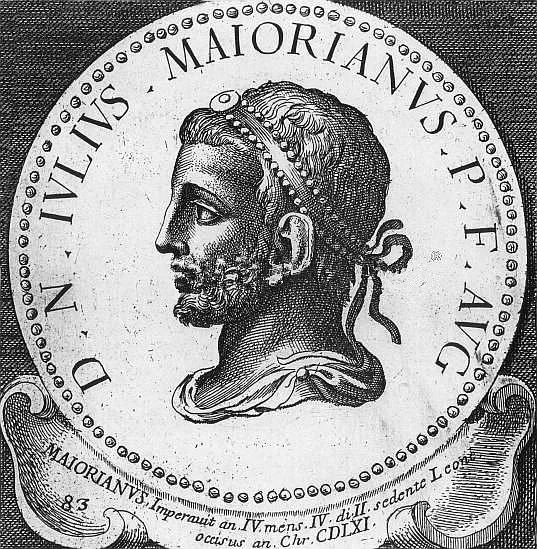
Majorian was Western Roman emperor from 457 to 461, during the final decades of the empire in the West. A military commander who personally led campaigns, he sought to recover territories lost to rival powers and strengthen the imperial government. His efforts achieved some success in Gaul and Hispania, but an attempted expedition against the Vandals in North Africa failed, and the powerful general Ricimer ultimately deposed and killed him.
A soldier rises to the throne
Majorian was born around 420 into a prominent Roman family. He built a military career during a period when generals and their armies often determined who held imperial power. He served under the general Flavius Aetius and later became a senior officer under Emperor Avitus. In 456, Majorian joined Ricimer in the campaign that removed Avitus from power.
After a brief political interregnum, Majorian was proclaimed emperor in 457 with Ricimer’s support and recognition from the Eastern Roman emperor Leo I. The partnership between the emperor and the general was uneasy from the beginning. Majorian was determined to rule actively and restore imperial authority, while Ricimer held great influence over the army and court.
Campaigns and reforms
Majorian personally led military operations beyond Italy. In Gaul, he secured support from local Roman elites and reached an accommodation with the Visigoths, helping restore imperial influence in parts of the region. He also campaigned in Hispania in preparation for an invasion of Vandal-controlled North Africa, which was a major source of Roman vulnerability and revenue.
The African expedition never took place. In 460, the Vandal king Gaiseric destroyed much of Majorian’s fleet, reportedly while it was assembled in Spain. Without the ships needed to cross the Mediterranean, the emperor abandoned the invasion and returned to Italy. The failure weakened his position and undermined the political partnership with Ricimer.
Majorian also issued laws aimed at repairing the finances and administration of the empire. Some measures sought to curb corruption and protect public buildings from being dismantled for private construction. The surviving laws, known as the Novellae Maioriani, reveal a ruler who viewed administrative reform as part of the effort to preserve Roman government.
Fall and legacy
In 461, as Majorian returned to Italy, Ricimer moved against him. The emperor was arrested, stripped of his authority, and executed near Tortona on August 7. His death ended one of the last serious attempts by a Western emperor to combine military campaigning with direct government across the remaining provinces.
Majorian’s reign lasted only four years, and his plans to recover Africa failed. Yet his campaigns and reforms distinguished him from many late Western emperors, whose power was largely confined to Italy and dependent on military strongmen. He is remembered as an energetic ruler who tried to restore imperial strength at a time when the Western Roman state was close to collapse.