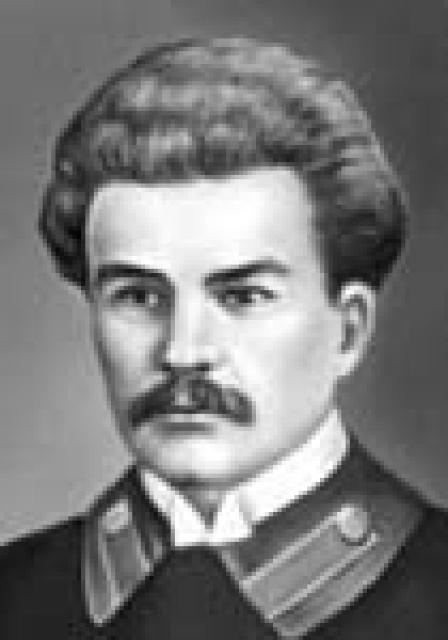
Maksim Bogdanovich
 Belarus
Biography of Maxim Bogdanovich
Maxim Adamovich Bogdanovich was a Belarusian poet, translator, literary critic, and publicist. He was born on November 27 (December 9), 1891, in a family of a renowned ethnographer and historian, A.E. Bogdanovich, who was one of the leaders of the local organization "Narodnaya Volya". Maxim studied at the Yaroslavsky Legal Lyceum and graduated from there. Unfortunately, he passed away at the age of 25 due to pulmonary tuberculosis.
Early Works and Publication
Maxim Bogdanovich made his first appearance in print in 1907 with a prose poem titled "The Musician" in the newspaper "Nasha Niva" published in Vilnius. His only collection of poems published during his lifetime, "The Wreath", was released in Vilnius in 1913 in the Belarusian language by the printing house of Martin Kukhta. The literary heritage of Bogdanovich was first fully collected and published by the Academy of Sciences of the BSSR in 1927-29 with the participation of the poet's father.
Contribution to Belarusian Literature
Bogdanovich is known as a translator of poetic works from Russian, Ukrainian, Polish, French, and other European languages into Belarusian. He wrote poems in both Belarusian and Russian, although the latter was significantly fewer. His fascination with Slavic folk poetry led Bogdanovich to create a poetic adaptation of an excerpt from "The Tale of Igor's Campaign" titled "The Song of Prince Izyaslav of Polotsk".
Bogdanovich perceived "The Tale of Igor's Campaign" as a work belonging to three Slavic cultures - Russian, Ukrainian, and Belarusian, and closely tied to the oral folk tradition. He highlighted the socio-aesthetic foundations of the poetic imagery in the monument, stating that "many passages in 'The Tale' are filled with images and comparisons... taken from the life of the peasant people."
Poetic Adaptation of "The Tale of Igor's Campaign"
Bogdanovich's poetic adaptation, which I.P. Yeremin considered a "free translation", reproduces a fragment about Prince Izyaslav Vasilkovich. It can be assumed that Bogdanovich preferred this particular "Song" because of its closing lines. For the poet himself, the translated excerpt from "The Tale" acquired a lyrical reminder of the ancient city, which had seen Teutonic knights and Mongols, Swedes and Napoleon, and had preserved the memory of the great Belarusian revolutionary Kastus Kalinowski and his friends.
Although Bogdanovich's adaptation of the fragment is generally close to the original text, it omits the words "edin' zhe" at the beginning, thereby not conveying the opposition of Izyaslav to other princes. The wordplay with the verb "pritrepati" is not reproduced in Bogdanovich's adaptation. The phrase "i s khotiyu na krovat'" (with the desire to lie down) which is one of the "dark places" of 'The Tale', did not make it into the adaptation. When describing how Izyaslav "dropped" his soul, Bogdanovich omitted the epithet "zhemchuzhnaya" (pearly), thereby removing an important Christian representation of the soul as a pearl. The epithet "khrabry" (brave) about Izyaslav's body was replaced by "udalaya" (courageous) about the soul.
Bogdanovich's adaptation of the fragment of "The Tale" is the first poetic reproduction of the monument's text in Belarusian. The complete translation into Belarusian was published only in 1921 by Yanka Kupala. N.V. Bannikov translated Bogdanovich's "The Song of Prince Izyaslav of Polotsk" into Russian.


