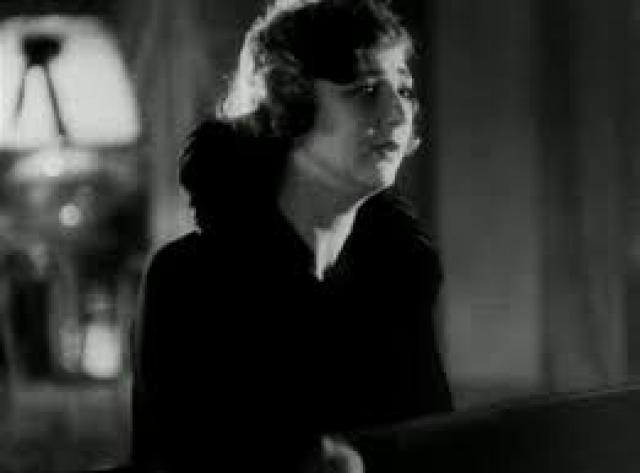
Mara Griy
Mara Griy was a singer and actress whose small screen legacy is tied to an unusually experimental moment in early sound cinema. Born around 1894 in Riga, then part of the Russian Empire, she left Russia during the upheavals that followed the Bolshevik Revolution and eventually settled in Paris. There she performed as a singer and became part of a circle of Russian émigré artists and patrons.
An émigré singer in Paris
Griy’s early life is only partially documented, and accounts vary on some family details. Her daughter, the later performance artist Rachel Rosenthal, recalled that her mother was born in Riga and came south to leave Russia after the revolution. By the 1920s, Griy was in Paris, where she pursued singing and hoped to appear in films.
Her connection with Léonard Rosenthal, a Russian-born Parisian pearl merchant and film producer, brought her into contact with the city’s cinema world. Rosenthal financed projects through Sequana Films, including a short that would become Griy’s most enduring screen credit. Their daughter Rachel was born in Paris in 1926 and later became an influential performance artist in the United States.
A singular role in Sentimental Romance
In 1930, Griy appeared as the singer in Romance sentimentale, also known as Sentimental Romance, directed by Sergei Eisenstein and Grigori Aleksandrov. The film was a short sound experiment made during Eisenstein’s European travels. Griy is its only on-screen performer: she sits at a piano and sings a Russian romance, while the directors use sound, music and montage to shape the mood around her.
The production did not become a conventional feature-film career for Griy, but its form has kept it in film histories and archival programs. Sentimental Romance is often discussed as an early example of cinema exploring how recorded music and images could work together. Griy’s performance anchors that experiment, placing a Russian song and an émigré singer at the center of a work by one of the twentieth century’s most influential directors.
Beyond the camera
Griy’s surviving filmography is limited, and details of her later performing career are harder to establish than the story of her Paris period. She is also associated with material connected to Eisenstein’s unfinished Mexican project, though surviving records do not clearly establish her as a performer in the film itself. Her best-documented role remains the 1930 short.
She died in 1975. Griy’s name is now most often encountered through the film and through the recollections of her daughter, whose later work took performance art in a very different direction. Though she left only a brief trace on screen, her presence in Sentimental Romance gives the experimental film a human center: a singer performing for the camera at a moment when cinema was learning how to record voices and music.