Marcian
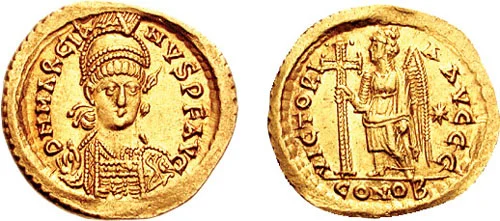
Marcian became Eastern Roman emperor in 450 after a career in the army. He was chosen during a succession crisis following the death of Theodosius II, and married Pulcheria, the late emperor’s sister, linking his rule to the Theodosian dynasty. His reign is remembered for a major church council and for a firmer policy toward the Huns.
From soldier to emperor
Marcian’s early life is only partly documented. Ancient accounts place his origins in Thrace or Illyria and describe a rise through military service. After Theodosius II died without a surviving son, Marcian was proclaimed emperor in 450 with the support of powerful court figures, including the general Aspar.
His marriage to Pulcheria was a political alliance as well as a personal arrangement. Pulcheria had taken a vow of chastity, and accounts of the marriage say that the couple agreed she would keep it. Their union helped lend dynastic legitimacy to Marcian’s accession.
The Council of Chalcedon
The most consequential event of Marcian’s reign was the Council of Chalcedon in 451. He arranged for the bishops to meet at Chalcedon, near Constantinople, and supported the council’s definition that Christ had both divine and human natures. This became the foundation of Chalcedonian Christianity, but it did not end the theological conflict; many Christians in Egypt, Syria, and elsewhere rejected the council’s settlement, and divisions endured.
Defending the empire
Marcian ended the Eastern Empire’s regular tribute payments to Attila the Hun and invested in defending its frontiers. While Attila campaigned in the Western Empire, Marcian’s government also mounted operations along the Danube. The eastern provinces largely avoided the devastation that had struck the West during Attila’s invasions.
Marcian died in 457, after seven years on the throne. He left the empire financially stronger and its frontier more secure, but the religious divisions sharpened at Chalcedon remained unresolved. His reign is thus remembered both for stability in imperial government and for a church settlement whose influence proved lasting and contentious.