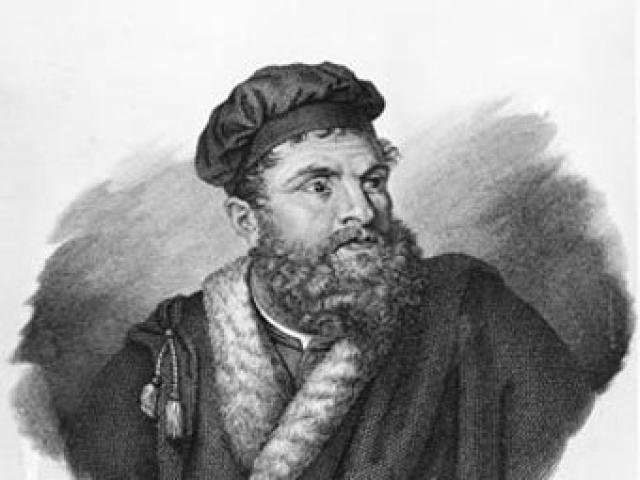
Marco Polo
 Italy
ItalyBiography of Marco Polo
Marco Polo, an Italian traveler, was one of the first Europeans to visit Eastern countries. He was born around 1254 in Venice or on the island of Korčula, which is now part of modern-day Croatia. Supporters of the Croatian origin theory believe that Marco Polo's father, Niccolò, and uncle, Maffeo, were of Eastern Slavic descent. Niccolò and Maffeo were merchants who traded with Eastern countries for many years, including traveling to the Volga River and Bukhara. In 1269, they returned to Venice from their latest journey, which took them to the dominions of Kublai Khan.
In 1271, Marco Polo, who was seventeen years old at the time, joined his father and uncle on their next journey. Pope Gregory X sent Polo to Asia, with the ultimate goal of their route being the city of Cambaluc (Beijing) in China, and the starting point being Venice. The descriptions of their route vary. Some researchers claim that Polo traveled through Acre, Erzerum, Ormuz, and the Pamir Mountains to Kashgar, and from there to Beijing. Others believe that the main points of their route were Acre, the southern coast of Asia, the Armenian Highlands, Basra, Kerman, the southern foothills of the Hindu Kush, the Pamir Mountains, the Taklamakan Desert, the city of Zhangye (which is already in China, and where the travelers spent about a year), and Karakorum. In 1275, regardless of the exact route, the merchants arrived in Beijing. They traded in China for many years, and Marco Polo served in the court of the great Khan Kublai and enjoyed the ruler's favor.
During his tenure, Marco Polo traveled extensively throughout China. Later, he was appointed as the governor of the province of Jiangnan. In total, Marco, Niccolò, and Maffeo Polo stayed in China for about seventeen years. In 1292, Polo left China and traveled to Persia, as they were tasked with escorting a Mongolian princess who was to be married to the Persian ruler.
In 1294, while in Persia, Polo received news of the death of the great Khan Kublai, after which they set off for their homeland. In 1295, Polo returned to Venice.
In 1297, Marco Polo participated in a naval battle between Venice and Genoa and was captured. He remained in captivity from September 1298 to July 1299. While in prison, he dictated his memoirs to another prisoner, a Pisan named Rustichello, which became known as "The Book." At that time, Polo's work was one of the few sources of knowledge in the Western world about Central, South, and East Asia. Although he was not a geographer, the distances in Polo's descriptions were greatly exaggerated, resulting in somewhat inaccurate maps being created. However, his skillfully described observations of life in Eastern civilizations proved to be invaluable. Thanks to Polo, Europe learned about paper money, cities with millions of inhabitants (although not everyone believed it), as well as the islands of Java and Sumatra, the country of Chipping (Japan), Ceylon, Madagascar, and Indonesia. It was through Marco Polo that Europe also discovered the spices that later became as valuable as gold. Little is known about Marco Polo's family, but he was married and had three daughters, as well as several close relatives. The Polo family had their share of difficulties, and sometimes even faced legal disputes.
On January 8, 1324, Marco Polo passed away in Venice. According to researchers, he was very wealthy in his final years. It is also known that before his death, Polo granted freedom to one of his slaves and left him a substantial sum of money.


