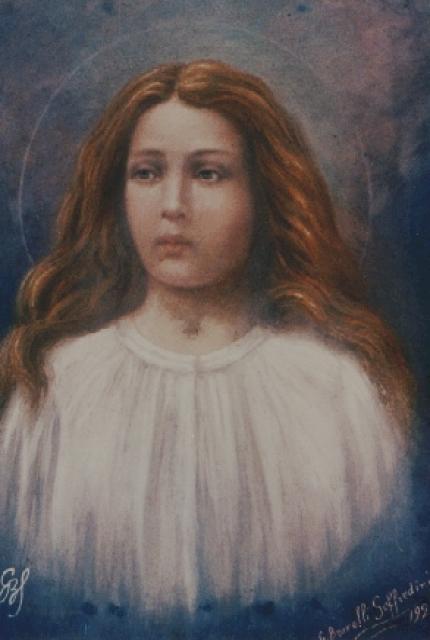
Maria Goretti
 Italy
Maria Goretti’s life was short and shaped by poverty, family responsibility and deep Catholic faith. She became one of the most widely known young saints in the Roman Catholic Church after she was killed at 11 while resisting a sexual assault. Her story has been told for generations as a testament to courage and forgiveness, while historians have also examined how devotional accounts shaped the way the Church presented her life.
Childhood and Family
Maria Teresa Goretti was born on October 16, 1890, in Corinaldo, in Italy’s Marche region. Her parents, Luigi Goretti and Assunta Carlini, were farm laborers. Work and poverty pushed the family to move repeatedly in search of a livelihood, eventually bringing them to the Pontine Marshes, near Nettuno, south of Rome.
Maria’s father died of malaria when she was nine. The loss left Assunta to support the children, and Maria took on household duties while her mother and older siblings worked. She cooked, looked after younger children, mended clothes and helped with the family’s small tasks. The family shared a farmhouse with the Serenelli family, whose members also worked the land. Maria received little or no formal schooling, but was known in Catholic accounts for her devotion to prayer. In 1902, still only 11, she made her First Communion earlier than usual.
The Attack and Her Death
On July 5, 1902, while the families were working in the fields, Maria was alone in the farmhouse with a younger sibling. Alessandro Serenelli, an adult member of the household, attacked her and attempted to rape her. She resisted and called out that he should not do it. He stabbed her repeatedly with a sharp tool, leaving her mortally wounded.
Maria was taken to hospital in Nettuno, where she died the following day, July 6. Catholic accounts say that before her death she identified her attacker and expressed forgiveness, hoping he might also reach heaven. Those words became central to how the Church later understood her story. The account remains a source of devotion for believers, though it is best read with the context that she was a child subjected to violence and that no one should mistake forgiveness for excusing the crime.
Serenelli was sentenced to 30 years in prison. He was initially unrepentant, but later said a dream involving Maria prompted a religious conversion. After serving 27 years, he sought forgiveness from Assunta. Vatican accounts describe her accepting him and attending Mass with him; he was later present, alongside Maria’s mother, at the canonization ceremony.
Beatification and Canonization
Devotion to Maria grew after her death. Pope Pius XII beatified her in 1947 and canonized her on June 24, 1950, in St. Peter’s Square. Her mother attended the ceremony, a striking public image of a parent witnessing the Church’s recognition of her child. Maria’s feast day is July 6, the date of her death.
The canonization emphasized her chastity and forgiveness, presenting her as a model for young Catholics. That public image became powerful well beyond Italy and helped make her one of the best-known modern child saints. At the same time, scholars have noted how the religious biographies and canonization process shaped the story into an ideal of feminine virtue. Historical work has drawn attention to the gap between a child’s ordinary life of labor and hardship and the elevated symbolic meaning attached to her death.
Legacy
Maria Goretti’s remains are venerated at a shrine in Nettuno, which continues to draw pilgrims. Her name is also carried by churches, schools and charitable institutions. For many Catholics, she represents steadfast faith and the possibility of forgiveness after grave harm. Her life also remains a painful reminder of the vulnerability of children and the lasting impact of violence. She is remembered not for a long public career, but for the way her brief life and death became a defining story in twentieth-century Catholic devotion.