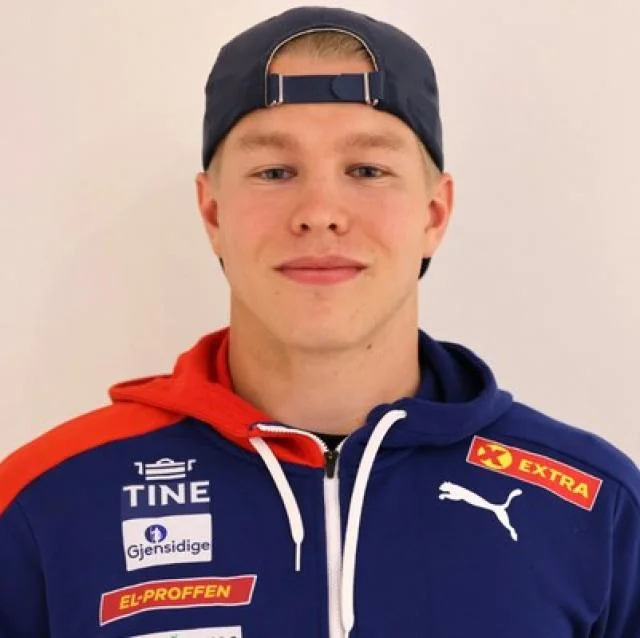
Markus Rooth
 Norway
- A young athlete finds his event
- The ten-event breakthrough in Paris
- A new standard for Norwegian athletics
Markus Rooth became one of Norway’s most surprising sporting heroes when he won the decathlon at the Paris 2024 Olympic Games. Over two days and ten events, the young Oslo athlete blended speed, power and endurance into a national-record score of 8,796 points. The victory made him the first Norwegian to win Olympic decathlon gold since 1920, and announced a new star in one of athletics’ most demanding disciplines.
A young athlete finds his event
Rooth was born in Oslo on 22 December 2001 and began training in athletics at the age of seven. He tried the sport’s many disciplines as a young competitor, and the decathlon’s variety suited him. Rather than concentrating on one event, he developed across sprinting, hurdling, jumping and throwing. He represented the Oslo club IL i BUL, and his father, Espen Rooth, became his coach and a key part of his development.
His early results showed that he could compete internationally. In 2020, he scored 8,238 points in the decathlon, a performance that placed him among the leading under-20 athletes in history. He continued to improve through the European age-group competitions, winning the European under-23 title in 2023 with a championship-record 8,608 points. At the senior World Championships in Budapest that year, he placed eighth, gaining valuable experience against the world’s best.
The ten-event breakthrough in Paris
Rooth arrived at the 2024 Olympics as a talented challenger rather than the favorite. The decathlon unfolded with the uncertainty that makes the event so compelling: every placing and personal best changes the points table, and one mistake can reshape the contest. Rooth stayed close to the leaders through the opening events, then made crucial gains in the pole vault and javelin. He took the overall lead before the final 1,500 metres and held on to win with 8,796 points, a Norwegian record.
Germany’s Leo Neugebauer finished second with 8,748, while Grenada’s Lindon Victor took bronze. Rooth’s tally included personal bests in the pole vault and javelin, and his performance showed the balance that defines a strong decathlete: no single event decided the gold, but a series of excellent efforts across the programme built the decisive margin. At 22, he was also among the youngest Olympic champions in the event in decades.
A new standard for Norwegian athletics
The victory carried particular weight in Norway, where the decathlon’s last Olympic gold had come from Helge Løvland in 1920. Rooth’s win brought renewed attention to combined events and to the breadth of skills they demand. He spoke afterward about the support of family, coaches and teammates, underscoring how a two-day performance is built through years of shared work.
Injuries affected his preparations after Paris and kept him out of the 2025 World Championships, interrupting the momentum of his Olympic breakthrough. Still, the gold in France established a landmark in his career and raised expectations for what might follow. Rooth’s story is a reminder that the decathlon rewards patience as much as power: its champion must be fast, explosive, technically precise and willing to grind through the final lap. In Paris, he proved himself across all ten tests and returned home with Norway’s first Olympic decathlon title in more than a century.