Marten Vos
 Belgium
Biography of Martin de Vos
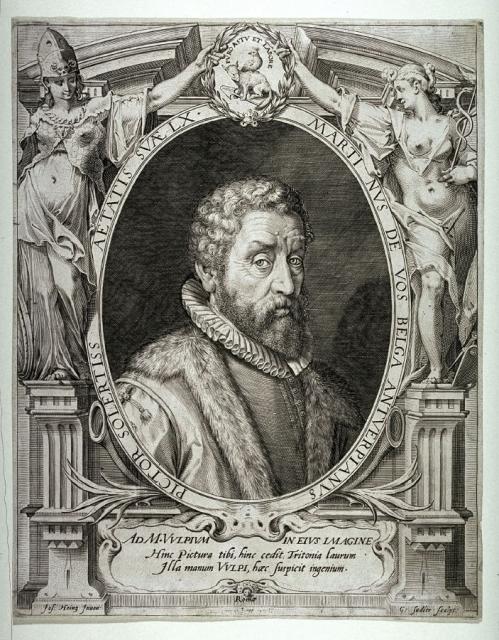
Martin de Vos was one of the leading artists of Flemish painting and graphics in the late 16th century. He was born in Antwerp around 1531. In 1558, he was accepted as a master in the Antwerp guild. Like his father and teacher Frans Floris, de Vos traveled to Italy to learn the techniques of Mannerism, a popular style at the time. During his trip, he met the famous Dutch painter Pieter Bruegel the Elder and together they visited Florence, Venice, and Rome. In Rome, de Vos painted the altarpiece "The Immaculate Conception" for the church of S. Francesco a Ripa. His works show a clear influence of the Venetian school of painting, possibly acquired during his time working in Tintoretto's studio as his assistant.
In 1560, Martin de Vos married Joanna Le Boucq, who became his lifelong love and only wife. They had eight children, one of whom also became an artist. After the iconoclastic riots in 1566, de Vos was one of the artists responsible for the restoration of church altarpieces in Antwerp. During this period, he created many significant works, such as "The Image of the Virgin" (1602), painted for the Chapel of the Guild of Saint Luke, and "The Marriage at Cana" (1597), painted for the wine altar of the Guild, which later became part of the collection of the Antwerp Guild Museum.
In 1572, Martin de Vos became the dean of the Antwerp Guild. His nephew Willem de Vos, who was also a member of the guild, later became an artist. De Vos was a versatile and prolific artist. He started his career painting portraits and figure scenes, but later focused on biblical and partly mythological subjects. He was greatly influenced by the renowned Dutch artist Pieter Aertsen. His later works are characterized by dynamism and warm, bright colors.
De Vos was also the founder of the Society of Romanists, which included famous artists, connoisseurs, and humanists of the time who visited Rome and highly valued its humanistic culture. He is also attributed with creating the oval image of Archangel Raphael and Young Tobias in the Mexico City Cathedral.
As a painter, Martin de Vos was particularly productive between 1580 and 1585, during the period of Calvinist rule in Antwerp. During this time, he created over 1600 works, including some of the most famous masterpieces of painting and graphic drawings, which served as models for engravings by renowned Dutch engravers of the period. He had the opportunity to create during the peak of the Netherlands' power and prosperity, known in art history as the Golden Age of Dutch painting.
His works can be found in many renowned museums around the world, such as the Guggenheim Museum in Bilbao (The Abduction of Europe), the Museum of Fine Arts and Archaeology in Châlons-en-Champagne (The Battle of Minerva with Venus), the Museum of Fine Arts in Seville (The Resurrection of Christ), the Courtauld Institute of Art in London, and the San Francisco Museum, which all have a series of works by the master.