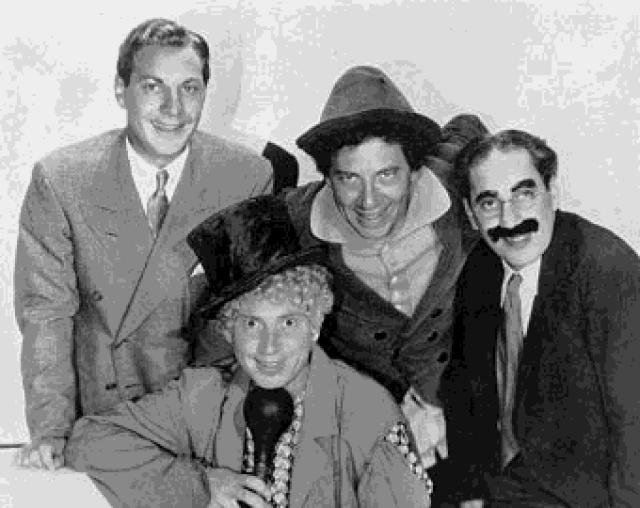
Marx Brothers
 USA
USA- The Rise of The Marx Brothers
- Early Life and Family
- The Core Trio: Chico, Harpo, and Groucho
- Multitalented and Exuberant
- Broadway and Beyond
- Films and Legacy
- Later Years and Individual Successes
- Enduring Legacy
The Rise of The Marx Brothers
The Marx Brothers, an American comedy quintet, soared to unprecedented heights of popularity in the 1930s. Their comedic style, characterized by inspired silliness—pie-throwing, slapstick, pratfalls, and other lowbrow antics—had audiences rolling on the floor in laughter.
Early Life and Family
Born in New York City to German and French Jewish immigrants, the five brothers hailed from a modest background on the Upper East Side, a melting pot of Irish, German, and Italian neighborhoods. Their father, Simon Marx (born Samuel), was a tailor from Alsace known as "Frenchy." Their mother, Minnie Schönberg, originated from Dornum in East Frisia.
The Core Trio: Chico, Harpo, and Groucho
The eldest three brothers—Leonard (Chico), Adolph (Harpo; later Arthur), and Julius Henry (Groucho)—formed the core of the Marx Brothers comedy troupe. Chico, the bumbling and slow-witted virtuoso pianist, Harpo, the mute fool with his iconic horn, and Groucho, the pompous businessman, each brought a unique character to the screen.
Multitalented and Exuberant
From an early age, the Marx brothers displayed remarkable talents. Harpo played six instruments, Chico was a proficient pianist, Groucho played guitar and sang, Zeppo also played guitar, and Gummo sang. They performed as the Marx Brothers under various names, including "The Six Mascots," featuring their mother and aunt.
Broadway and Beyond
Their breakthrough came on Broadway with the musical comedy "I'll Say She Is." In the late 1920s, the Marx Brothers ventured into film with "The Cocoanuts." They emerged as rivals to the legendary Charlie Chaplin, but their brand of surreal and chaotic comedy was a refreshing departure from Chaplin's "little tramp."
Films and Legacy
Their iconic films include "Monkey Business" (1931), "Horse Feathers" (1932), "Duck Soup" (1933), "A Night at the Opera" (1935), and "A Day at the Races" (1937), which had audiences in stitches with their endless stream of absurd situations and witty wordplay.
Later Years and Individual Successes
The quintet gradually disbanded in the 1940s, each brother pursuing their own paths. Groucho became a successful television game show host and author, while Harpo published an autobiography titled "Harpo Speaks!" (1961).
Enduring Legacy
Despite their limited popularity in their native country, the Marx Brothers left an indelible mark on comedy worldwide. Their films are still celebrated today as masterpieces of slapstick and verbal dexterity. Their fame rivals that of comedy greats like Charlie Chaplin, cementing their status as true "Giants of Laughter."


