Mel Fisher
 USA
USABiography of Mel Fisher: The King of the Underwater World
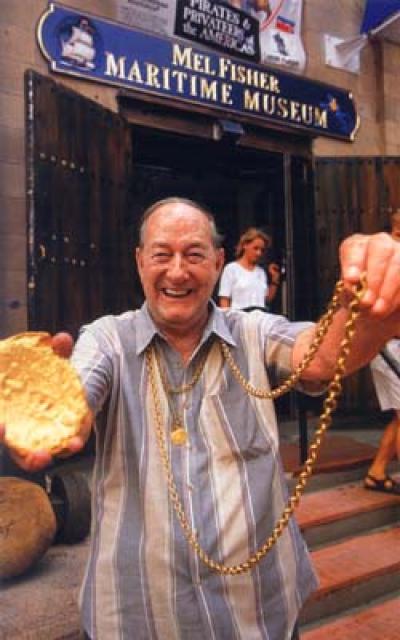
Mel Fisher, an archaeologist, is often referred to as the king of the underwater world and legends still circulate about him. His headquarters were located on board a galleon anchored in the sea. Fisher's agents spent a long time searching for a suitable-sized sailing ship, which they eventually found in Europe. They towed it to Florida and the best carpenters turned the old hulk into an exact replica of a Spanish galleon. Today, the ship serves as a museum where Fisher displayed the best of his findings - gold coins and bars, chains, earrings, crucifixes, diamonds, emeralds, and even a magical bezoar stone, which was believed to cure all ailments.

The Spanish galleons in the 17th century were gigantic vessels made of sturdy Manila oak. They had three masts, a stern adorned with intricate carvings, forty heavy cannons, and a cargo hold filled with gold. They sailed from Cadiz to the Philippines via Havana and Veracruz, and then back to Spain. The amount of money transported on each ship could support a small army. However, these floating safes had poor maneuverability, and one by one, the galleons met their demise. The California coast is now littered with shipwrecks and gold coins, and the seabed holds millions of dollars worth of treasure. But getting to them is not easy, as the anchors and frames are covered in coral and the gold and diamonds are buried deep in the mud. To retrieve $1,000, one would have to spend $10,000, and many treasure hunters lost their fortunes and even their lives in pursuit of Spanish gold.
Half a century ago, Mel Fisher was a destitute and unknown man full of hopes. He took on any job that could bring in money and put his heart and soul into each endeavor. In the early 1930s, the state of Indiana was rich in enthusiasts. Mel, a scrawny boy from a small town, was constantly inventing things. One of his inventions, a diving helmet made from an old pot, a garden hose, and a bicycle pump, still proudly sits on the shelf in the admiral's cabin of his galleon. He worked on his father's farm and played the trumpet in the local orchestra. Later, he studied engineering at the University of Alabama, and during World War II, Fisher's unit followed the troops, reconstructing roads and bridges. After the war, he moved to California and started raising chickens. It was there that he discovered his lifelong passion. With the sea nearby, Mel opened a small dive shop where he sold and rented diving equipment. The daughter of a neighboring farm, a red-haired and playful woman named Dolores, took diving lessons from him, and a few months later, they were married. The Fishers sold all their chicken stock as the underwater world was far more exciting and profitable. Mel and Dolores gave diving lessons, made films about marine life, and gradually became fascinated with treasure hunting as the vast treasures were within their reach with scuba gear.
In 1612, a storm scattered and wrecked the "Silver Fleet," leaving Spain unable to maintain its army. In 1715, a convoy carrying gold and emeralds sank to the bottom of the sea after a year of labor by gold miners from Potosi and indigenous people forced to work in Colombian emerald mines. Storms spared no one, and the admiral commanding the galleon "Nuestra Senora de Atocha" gathered his officers, discussed the last sonnet by Lope de Vega, said a prayer, and drowned with dignity befitting a Castilian nobleman. The exact coordinates of the shipwreck were lost. Mel had to find a needle in a haystack while being closely watched by state authorities ready to confiscate any valuable findings. He had no chance, but he was Mel Fisher. To draw attention to the search, his wife set a world record for the longest time spent underwater by a woman. Dolores spent 55 hours in a bathysphere, drinking juice, eating bananas, and reading old newspapers. Money was no longer the issue; they were both willing to risk everything for their dream. Even experienced divers succumbed to Fisher's enthusiasm. The "Silver Fleet" was now being searched for by a team of enthusiasts, and Mel came up with clever tricks for investors. He offered each of them a chance to participate in the search, providing them with scuba gear and a metal detector, and then sent them to a location where he had carefully buried two or three gold coins the day before. The lucky person would be warmly welcomed on the shore, and the whole team would celebrate in the evening, with a feast of grilled lobsters and langoustines, toasting to their success. Even bankers, who had never lent money to Mel before, quickly became his allies.
The treasure hunt continued for over 20 years. Random findings such as a huge Spanish anchor, several gold coins, a fragment of a gold chain, and a pair of silver-plated pistols ignited the imagination, but the unpaid bills kept piling up. For many years, luck eluded Fisher, and before he could claim his treasures, the sea demanded sacrifices from him. In 1975, a wave overturned a boat carrying Mel's eldest son Dirk, his wife Angela, and two divers. They all perished as a storm struck unexpectedly, and the treasure hunters hadn't had time to put on their life jackets. Those who managed to stay afloat were dashed against the coastal rocks.
After his son's death, Fisher changed beyond recognition. He was once a great optimist, greeting each new day with the phrase, "Seize the day!" Now Mel became gloomy and seemed to be intentionally seeking death. He swam across a lagoon infested with sharks and ventured into the rough sea on a fragile boat. One day, the boat capsized, and only chance saved him. A passing cargo ship spotted him. By that time, Mel had been in the open ocean for several hours. It was as if he was challenging the elements, and they, testing his resilience, finally relented. One fine day, Greg Worcham, a diver from Fisher's team, discovered a cache of silver bars marked with the Spanish crown symbol. "Nuestra Senora de Atocha" revealed to Mel the contents of its holds. Soon after, the divers found a large underwater reef, where their metal detectors went haywire: under a mound of sediment lay thousands of large silver bars and three thousand boxes of gold coins.
The treasure hunters were presented with a truly fantastic sight. Among the seaweed and coral, with colorful fish lazily swimming around, lay a carpet of gold doubloons, each worth no less than ten thousand dollars. Fisher used an invention of his own, a giant vacuum-like device, to clear away the silt. A large tube was lowered, sucking up the sediment from the bottom. When the compressor was turned off, the diver on duty at the worksite gasped. He was showered with a rain of emeralds and amethysts, the precious stones shimmering in the seawater, slowly swirling and settling on the seabed - there were several thousand of them.
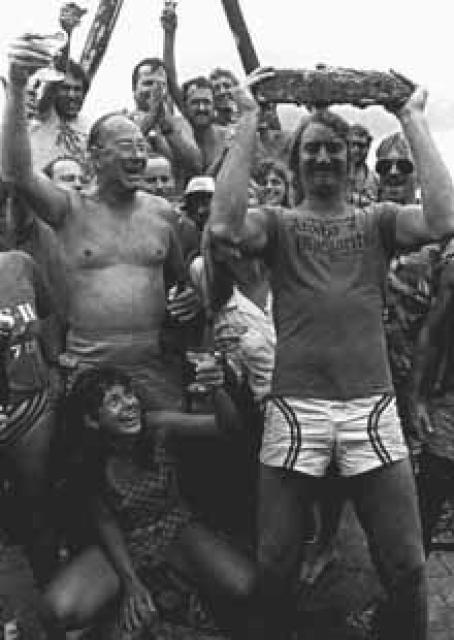
"Nuestra Senora de Atocha" was carrying the precious gemstones for the Spanish king, but most of the emeralds in the galleon's cargo hold were smuggled. Giant diamond earrings, too heavy for any woman's ears, were specially made to hide the stones from taxation. Every day brought new discoveries, and the divers posed for photos on small underwater reefs that had turned into piles of silver. Twenty percent of their findings went to the state, another twenty percent to the investors, and the rest belonged to Mel Fisher.
Since then, his luck never left him. He found an equally rich galleon, the "Santa Margarita," and later a conquistador's caravel. From the caravel, they recovered cannons, corroded helmets, bronze coins, and halberd heads. Fisher became a legend on the California coast and entered the history of underwater archaeology. Nobody else has made as many fantastic discoveries as he did.
Those who write about Fisher consider him lucky, but those who knew him closely prefer not to talk about it. Until his death in December 1998, he could not forgive himself for not stopping Dirk from going to sea and not reminding him about the storm warning.