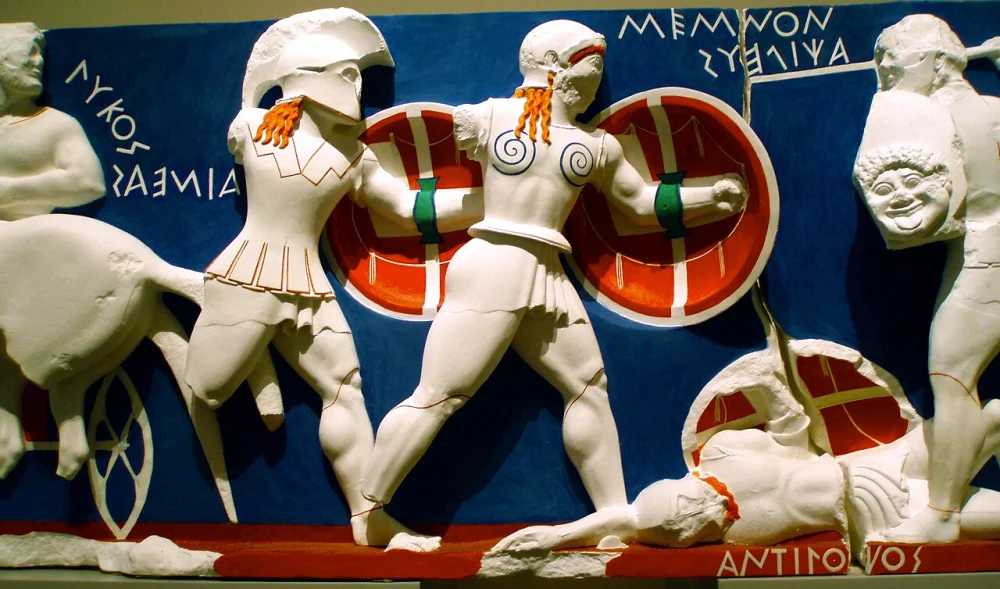
Memnon
In Greek myth, Memnon was a powerful king from Ethiopia who came to Troy after the death of Hector. The son of the dawn goddess Eos and the Trojan prince Tithonus, he was celebrated as a formidable warrior whose fate mirrored that of Achilles. His story was told most fully in the lost epic Aethiopis, known today through summaries and later retellings.
A king born of dawn
Memnon was the son of Eos, goddess of the dawn, and Tithonus, a prince of Troy. Ancient Greek writers called him king of the Ethiopians, though the word “Ethiopia” in Greek geographical writing could refer to lands south or east of Egypt rather than to the borders of the modern country. In myth, Memnon led a distant host of warriors to support his uncle, King Priam.
The Trojan War and the duel with Achilles
Memnon arrived after Achilles had killed the Trojan champion Hector. In the post-Homeric war cycle, he fought for Troy and killed Antilochus, the son of Nestor. Achilles then challenged him to single combat. The two heroes were often portrayed as closely matched, and their mothers, Eos and Thetis, appealed to Zeus as the battle unfolded.
Achilles killed Memnon, but the stories did not end with his death. Eos mourned her son, and some versions say Zeus made him immortal. Another tradition held that birds rose from his funeral pyre and fought each year at his tomb, turning his mourning into an enduring ritual.
A legend beyond the epic
The fullest early account of Memnon’s role belonged to the Aethiopis, a lost Greek epic that continued the Trojan War story beyond the events of Homer’s Iliad. Later poets and artists returned to the image of the Ethiopian king, emphasizing his courage, his exotic distant kingdom, and the grief of his divine mother.
Memnon’s myth offered a striking counterpart to Achilles: another great warrior, born of a divine mother and a mortal father, whose arrival briefly renewed Troy’s hopes before fate brought him down. His story became one of the enduring episodes in the wider Greek tradition about the fall of Troy.