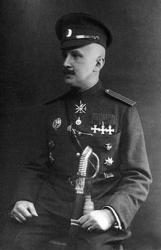
Michael Glinskiy
- Early Life and Education
- Rise in the Lithuanian Court
- Rivalry and Ambitions
- Military Success and Conflict
- Alliance with Moscow
- Intervention of the Polish-Lithuanian King
Early Life and Education
Born into the Glinsky family, Mikhail Glinsky inherited vast wealth and estates. Displaying exceptional intelligence, he spent 12 years abroad, learning various languages and serving in the armies of Albert of Saxony and Maximilian I. During his time in Italy, he converted to Catholicism and traveled to Spain, gaining fluency in several European tongues.
Rise in the Lithuanian Court
Upon his return to Lithuania, Glinsky gained favor with King Alexander, who frequently consulted him. In 1499, he was appointed Marshal of the King's Court and accompanied the king to Krakow for his coronation as an ambassador from Lithuania.
Rivalry and Ambitions
Glinsky's immense wealth allowed him to acquire supporters, particularly among the Russian boyars. The Lithuanian nobility feared that he might seize power upon Alexander's death, moving the capital to Russia and seeking its support. Suspicions arose that Glinsky had attempted to poison the king during an encounter with the doctor, Balinsky.
Military Success and Conflict
Despite his victories against the Crimean Khanate, including the Battle of Kleck in 1506, Glinsky only fueled further envy and hatred among the nobility. After the king's death, the lords refused to permit the body to be sent to Krakow, fearing Glinsky's influence in their absence.
Glinsky's enemies prevented him from meeting with the newly arrived King Sigismund, leading him to demand a trial against his accusers. However, Sigismund remained hesitant. When appeals to the Hungarian King Vladislav failed, Glinsky, along with his brothers Ivan and Vasily, retreated to their estate in Turov.
Alliance with Moscow
In 1508, Glinsky officially declared a rebellion, besieging Minsk with his brother Vasily. Unsuccessful in capturing it, he turned his attention to Kleck. The brothers divided their forces, with Vasily raising Russian support in Kiev and Mikhail devastating the Slutsk and Kopylsk regions.
With reinforcements from Moscow led by Evstafy Dashkovich, Glinsky concluded agreements with Moscow, Moldavia, and Crimea, acting as a de facto sovereign. Moscow's forces besieged Minsk with Glinsky and sent detachments towards Vilna.
Intervention of the Polish-Lithuanian King
King Sigismund responded by marching his army to the aid of his subjects. Glinsky's forces faced setbacks as the king lifted the siege of Orsha and forced them to retreat.