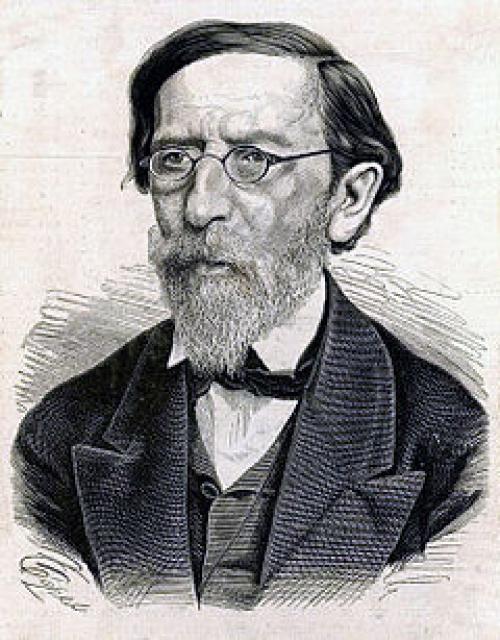
Michael Maksimovich
 Russia
- Early Life and Education
- Academic Career
- Research in Natural Sciences
- Ethnological and Linguistic Studies
- Historical and Literary Investigations
- Role in Ukrainian History and Identity
- Literary and Artistic Endeavors
Early Life and Education
Mikhail Aleksandrovich Maksimovich, a renowned Russian and Ukrainian scholar, was born in 1804. He studied at the Novgorod-Seversk Gymnasium and Moscow University, where he pursued both the humanities and natural sciences.
Academic Career
In 1831, Maksimovich defended his master's thesis, "On Systems of the Plant Kingdom," earning the position of adjunct. In 1832, he was dispatched to the Caucasus, from where he returned with extensive collections. Upon his appointment as rector of Kyiv University, he was forced to occupy the chair of Russian literature at the behest of Count Uvarov, who saw Maksimovich as a means to establish a Russian university in the Polonized region.
Research in Natural Sciences
Prior to his tenure in Kyiv, Maksimovich published a series of works in natural sciences, including "On Systems of the Plant Kingdom," "Foundations of Botany," "Main Principles of Zoology," "Reflections on Nature," and "The Book of Naum on the Great Divine World." The latter, a popular science publication, went through six editions by 1851. Maksimovich also played a significant role in replacing foreign scientific terminology with Russian equivalents.
Ethnological and Linguistic Studies
Maksimovich's interest in ethnology began early on. In 1827, he published "Little Russian Songs" with commentaries. In 1834, he released a second collection, "Ukrainian Folk Songs," and "Voices of Ukrainian Songs," featuring musical arrangements by A.A. Alyabyev. He embarked on an even more ambitious project in Kyiv with the publication of "A Collection of Ukrainian Songs." His study of folk literature led him to investigate the Russian (particularly South Russian) language and literature. Notable works in this area include "Critical-Historical Research on the Russian Language" and "Elements of Russian Philology."
Historical and Literary Investigations
Maksimovich's research extended to the ancient period of Russian literature, with a focus on "The Tale of Igor's Campaign" and South Russian literary monuments. His contributions include "History of Ancient Russian Literature," "On Folk Historical Poetry in Ancient Rus," "The Song of Igor's Campaign," and "Contributions to the Explanation and History of The Tale of Igor's Campaign." These works solidified his position as a prominent scholar in the field of ancient Russian and South Russian history.
Role in Ukrainian History and Identity
As a strong advocate for the existence of a distinct "South Russian" language, Maksimovich opposed the views of his "northern" friend, M.P. Pogodin. This led to the famous dispute between the "Southerners" and "Northerners" regarding the antiquity of the Little Russian language. Maksimovich argued that South Russian history was genetically linked to ancient Kyiv and that the Little Russian people descended from ancient Rusyns. His scholarship on the history of Little Russian Cossacks was characterized by its critical nature, and he paved the way for subsequent scholars like V.B. Antonovich and A.M. Lazarevsky.
Literary and Artistic Endeavors
Maksimovich's academic pursuits did not preclude his involvement in literary and artistic endeavors. He edited the almanac "Denitsa," which featured works by Pushkin, Venevitinov, Vyazemsky, Delvig, Khomyakov, Baratynsky, Yazykov, Merzlyakov, and Ivan Kireevsky. He also translated psalms and "The Tale of Igor's Campaign" into Little Russian and wrote original poems in that language. Despite his close association with Ukrainophilism, Maksimovich maintained a broader Russian identity, refusing to separate Ukraine from the rest of Russia.


