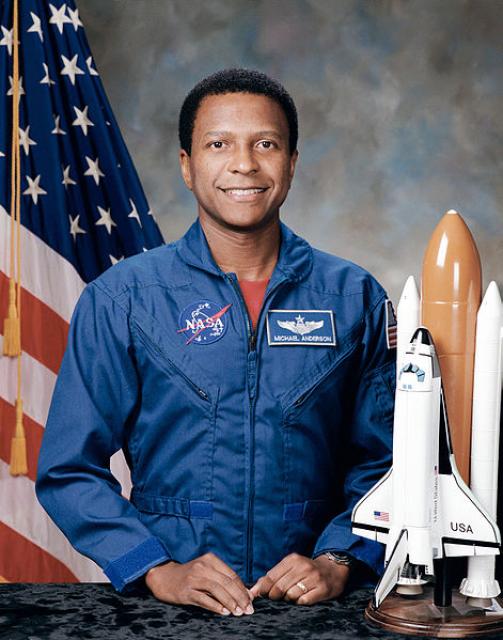
Michael Phillip Anderson
 USA
USA- Biography of Michael Philip Anderson
- Early Life and Education
- Military Career
- Astronaut Career
- Awards and Legacy
Biography of Michael Philip Anderson
Michael Philip Anderson was an American pilot and astronaut. He had a total flight time of over 3,000 hours on various aircraft models such as KC-135 and T-38A. Anderson completed two space missions, totaling 24 days, 22 hours, 21 minutes, and 23 seconds. Unfortunately, he tragically lost his life in the space shuttle Columbia disaster during its return to Earth. He is buried at Arlington National Cemetery.
Early Life and Education
Michael Philip Anderson was born in Plattsburgh, New York, but considered Spokane, Washington, his hometown. In 1977, he graduated from high school in Cheney, Washington. He went on to receive a Bachelor of Science degree in Physics and Astronomy from the University of Washington in 1981. Anderson furthered his education by obtaining a Master of Science degree in Physics from Creighton University in 1990.
Military Career
From 1981 to 1982, Anderson underwent technical training at Keesler Air Force Base in Mississippi. In 1982, he was assigned to Randolph Air Force Base in Texas. He served as the Chief of the Communication Maintenance Division in the 2015th Communications Squadron and later as the Chief of the Information Systems Maintenance Division in the 1920th Information Systems Group.
Anderson began flight training at Vance Air Force Base in Oklahoma in 1986. Upon completion, he became a pilot of the EC-135 aircraft in the 2nd Airborne Command and Control Squadron at Offutt Air Force Base in Nebraska. From January 1991 to February 1992, he served as the aircraft commander and instructor pilot in the 920th Air Refueling Squadron at Wurtsmith Air Force Base in Michigan. From September 1992 to December 1994, he worked as an instructor pilot and tactics officer in the 380th Air Refueling Wing at Plattsburgh Air Force Base in New York.
During his military career, Anderson achieved the rank of Major in 1994 and Lieutenant Colonel in 2000.
Astronaut Career
In December 1994, Michael Anderson was selected as a mission specialist by NASA and joined the astronaut corps. After completing a year-long general astronaut training program, he qualified as a mission specialist and was assigned to the Flight Support Branch of the Astronaut Office.
On January 22, 1998, Anderson embarked on his first spaceflight as a mission specialist on the STS-89 mission of the Space Shuttle Endeavour. The primary objective of the mission was to dock with the space station Mir and exchange crew members. He became the 374th person and the 237th American to venture into space. The duration of the mission was 8 days, 19 hours, 46 minutes, and 54 seconds.
On September 28, 2000, Anderson was assigned to the STS-107 mission of the Space Shuttle Columbia as a payload commander. On January 16, 2003, he embarked on his second spaceflight as a mission specialist and payload commander. Unfortunately, tragedy struck when the Columbia disintegrated during re-entry on February 1, 2003, claiming the lives of all seven crew members.
Awards and Legacy
Michael Philip Anderson was posthumously honored with several awards, including the Department of Defense Medal for Distinguished Service, the Air Force Commendation Medal, and the Air Force Achievement Medal. He was also awarded the Congressional Space Medal of Honor and the Presidential Medal of Freedom.
In October 2005, a memorial statue was erected in his honor in his hometown of Spokane, Washington. The unveiling ceremony was attended by his widow and former astronaut Frederick D. Gregory, who was then the Deputy Administrator of NASA.
Anderson's name is immortalized on the Space Mirror Memorial, a tribute to fallen astronauts located at the Kennedy Space Center in Florida.
According to official documents, Michael Anderson was born in Plattsburgh, New York, but he considered Spokane, Washington, his true home.