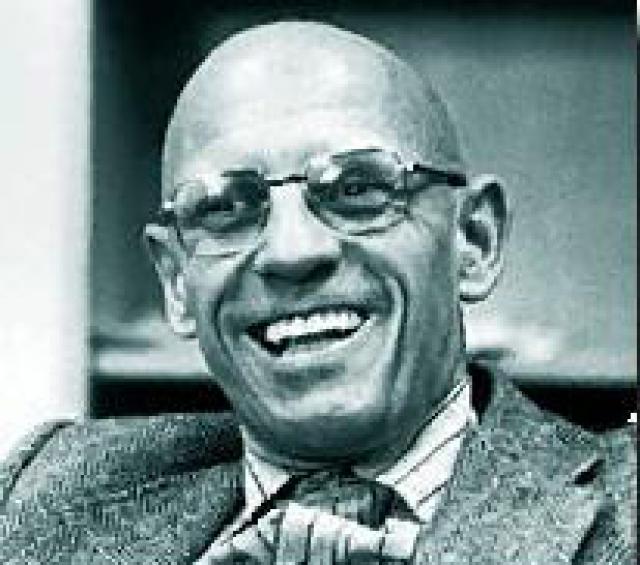
Michel Foucault
 France
Biography of Michel Foucault
Michel Foucault was a French philosopher, historian, and theorist of culture, and a prominent figure in contemporary French structuralism. He was born on October 15, 1926, in Poitiers, France. His father was a well-known surgeon in the region who hoped that his son would follow in his footsteps. However, when it became clear that young Foucault was introverted and had delinquent tendencies, his father sent him to study at Saint Stanislaus College, a strict Catholic school known for its discipline and order.
Foucault excelled as a student in school, and after completing his education at Saint Stanislaus College, he entered the prestigious Henri IV lyceum in Paris. In 1946, he was admitted to the Pedagogical Institute, where he ranked fourth among the strongest applicants. Studying philosophy under the renowned Maurice Merleau-Ponty, Foucault demonstrated remarkable intelligence. Within a few years, he obtained a bachelor's degree in philosophy, followed by degrees in psychology and psychotherapy.
Foucault taught French at Uppsala University in Sweden, then spent a year at the University of Warsaw and another year at the University of Hamburg. In 1960, he returned to France and became the dean of the Faculty of Philosophy at the University of Clermont-Ferrand. In the same year, his brilliant work "Madness and Civilization" was published, in which he argued that "madness" and the meticulous and convoluted distinctions made between this concept and "reason" are nothing more than stereotypes of an era dominated by reason and skepticism. This book earned Foucault a doctorate.
In the same year, Foucault met Daniel Defert, a student at the Faculty of Philosophy who was ten years younger than him. Defert's political activism had a significant influence on Foucault's development. In an interview, Foucault described their relationship: "For eighteen years of my life, I lived in a state of passionate devotion to one person. At some point, this passion turned into love. But, to tell the truth, we experienced this passionate infatuation together."
Foucault gained recognition in France with his book "The Order of Things," which brought him fame, at least among intellectuals. The controversial statement at the end of the book, claiming that "man," the last contradictory formation made possible by the radical changes in the systematization of knowledge over the past 150 years, is approaching its end, sparked widespread discussion. If Friedrich Nietzsche proclaimed the death of God, Foucault predicted the death of man.
When Daniel Defert volunteered for service in Tunisia, Foucault followed him and engaged in teaching activities (and developed a drug addiction). They returned to Paris together, with Foucault taking on the role of the head of the philosophy department at the University of Vincennes and Defert teaching sociology. This happened shortly after the student protests of May 1968 reached their peak. The riots had a profound impact on Foucault. In the same year, he participated in the creation of the GIP (Information Group on Prisons) along with other intellectuals. The organization aimed to give prisoners a voice to express the problems they faced in prisons.
In the last ten years of his life, Foucault dedicated his work to "The History of Sexuality," a monumental but unfinished project. The first volume, "Introduction," was published in 1976 and sparked much debate. The second and third volumes, "The Use of Pleasure" and "The Care of the Self," were released shortly before his death. His time in San Francisco, where he taught at the University of California, Berkeley, was a turning point in his career. He was struck by the sexual liberation of the gay community, particularly evident in the bathhouses he visited. He wrote, "I believe it is essential for sexual desires to be realized in the same way they are in bathhouses. There, you meet men who have the same attitude toward you as you do toward them: all you have is your bodies, and through various variations, you can achieve pleasure. You become liberated outwardly, unburdened by the past, and free to express yourself."
Foucault found particular interest in the "limited experience" of S/M. He expressed his views on this matter, saying, "I don't think this sexual direction is similar to exploring and studying S/M inclinations in the depths of our subconscious. I believe S/M goes beyond these narrow boundaries; in fact, it creates new possibilities for pleasure that people were not aware of before." For several subsequent years, he repeatedly returned to San Francisco, making his final visit in 1983 when the AIDS epidemic was rampant in the bathhouses, and he himself was ill (although he likely did not know it at the time).
Ten years after Michel Foucault's death on June 25, 1984, due to complications from AIDS in Paris, his ideas about the evolution of Western civilization over the past three centuries continue to hold immense significance. His influence on the consciousness of the gay community, especially after the publication of the first volume of "The History of Sexuality," was substantial. Foucault's theory of social construction argues that sexuality is not a natural and immediate expression but a cultural model that varies significantly over time and place. He claimed that the modern homosexual and heterosexual are inventions of the relatively recent past, and before the 18th century, there were only homosexual or heterosexual acts without distinct identities. His work sparked discussions on the nature of sexuality and its historical and cultural context.
In his final years, Foucault's revolutionary ideas focused on what he called "exaggerated and pessimistic activity." It is undeniable that the influence of these ideas continues to grow. Foucault's place in history is solidified in the book "Friend, Who Did Not Save My Life," alongside Andy Warhol and John Cage. Each of them brought about a revolution in their respective fields. By considering Foucault as the first among these three remarkable individuals, it demonstrates the understanding that his work relates primarily - in fact, most directly - to contemporary issues of sexual orientation for gay and lesbian individuals.



