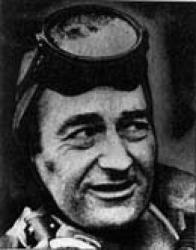
Mihail Makarov
 Germany
Biography of Mikhail Makarov
Mikhail Makarov was a Soviet intelligence officer during World War II. He was born into a poor family and lost his father at a young age. After completing seven grades in his hometown, he moved to Moscow and enrolled in the Institute of Foreign Languages.
On December 14, 1933, Makarov received his Soviet passport in Moscow. He became a translator and was sent to Spain, where he trained as a gunner and participated in combat flights. He also graduated from the GRU reconnaissance school.
In New York on October 16, 1936, he obtained a Uruguayan passport under the name Carlos Alamo. He married Aleksandra Petrova, who was born as Schmidt or Schmidt, while in Brussels. As an engineer by profession, Makarov was a lieutenant in the Red Army and specialized in forging counterfeit documents.
In March 1939, Makarov was sent as a radio operator to assist Leopold Trepper. He traveled from the USSR to Stockholm and then to Paris through Copenhagen. After recruiting Reinhard Rahn as an accomplice, Makarov was relieved of the task of producing counterfeit documents and focused on radio communication. He received training in radio operations from Johan Wenzel. Trepper provided cover for Makarov by appointing him as the owner of the Excellent Raincoat Company branch in Ostend, where he was instructed to set up a transmitter for communication.
While in Ostend, Makarov lived with Karolina Horrix, the wife of Guillaume Horrix. In May 1940, after a bombing raid on Ostend, which damaged the company's premises, Makarov returned to Brussels. He managed to establish communication with the Moscow center.
In the summer of 1941, his assistant in Brussels became Danilov, who was under Makarov's command. Their transmitter was located at 101 Atrebatt Street, owned by Rita Arnu and Sofia Poznanska. Danilov was arrested by the Germans during a communication session on the night of December 12-13, 1941, and Makarov was captured the next morning.
According to Belgian police records, Makarov was imprisoned in St. Gilles prison, sentenced to death, and executed in the Berlin Ploetzensee prison in 1942.
He was posthumously awarded the Order of the Red Banner and the Order of the Red Star.