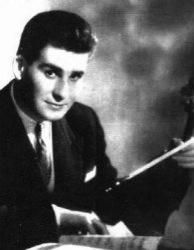
Mihay Kuttner
- Early Life and Musical Training
- A Career in Chamber Music
- Teaching and Conducting
- Personal Life and Legacy
Mihály “Michael” Kuttner was a Hungarian-American violinist whose career moved from Budapest’s close-knit musical circles to the concert stages and teaching institutions of the United States. A gifted chamber musician, he became the second violinist of the Hungarian String Quartet and later joined the faculty of Indiana University, where he taught until his death.
Early Life and Musical Training
Kuttner was born in Budapest on December 9, 1918. He studied at the Franz Liszt Academy of Music, one of Central Europe’s leading conservatories, where his teachers included violinist Ferenc Gábriel, composer and chamber-music teacher Leó Weiner, and violinist Imre Waldbauer. His studies brought him into the traditions of Hungarian string playing and chamber music that shaped his professional life.
He received recognition early in his career, including the Reményi prize, which came with a violin from Budapest luthier László Reményi. As a Weiner prize winner, Kuttner helped form a quartet in 1939 with pianist and violinist colleagues. The group premiered Weiner’s *Pastorale, Fantasy and Fugue*, his Third String Quartet, a work that reflected the composer’s distinctive blend of Hungarian musical language and classical form.
A Career in Chamber Music
Kuttner emigrated to the United States in 1940, as war engulfed Europe. He continued to build a career as a chamber musician, appearing with several ensembles, including the Pro Ideale, Gordon, Lener, Hungarian and Berkshire quartets. With the Pro Ideale Quartet, he served as first violinist and was part of its residency at Westminster Choir College.
In 1959, Kuttner joined the Hungarian String Quartet as its second violinist. The ensemble, founded in Budapest in 1935, had established an international reputation for its performances of the classical and romantic quartet repertory. Kuttner remained with the group through its final years, touring and recording with fellow Hungarian musicians Zoltán Székely, Gábor Magyar and Dénes Koromzay. The quartet disbanded in 1972.
Teaching and Conducting
Alongside his work as a performer, Kuttner pursued teaching and conducting. He studied conducting with Serge Koussevitzky at Tanglewood and conducted productions for the New York City Opera and Trenton Opera. In 1972, he joined the music faculty at Indiana University in Bloomington, bringing decades of performance experience to its students.
His work connected a generation of young musicians with the chamber traditions he had learned in Budapest and carried into his American career. At Indiana, his legacy continued through a fund established from his estate to support string students and string-quartet activity.
Personal Life and Legacy
Kuttner died in Bloomington, Indiana, on October 10, 1975. He is remembered for a career that joined the musical worlds of Hungary and the United States: from his conservatory training and early quartet work in Budapest to his long service with the Hungarian String Quartet and his later teaching in Indiana.