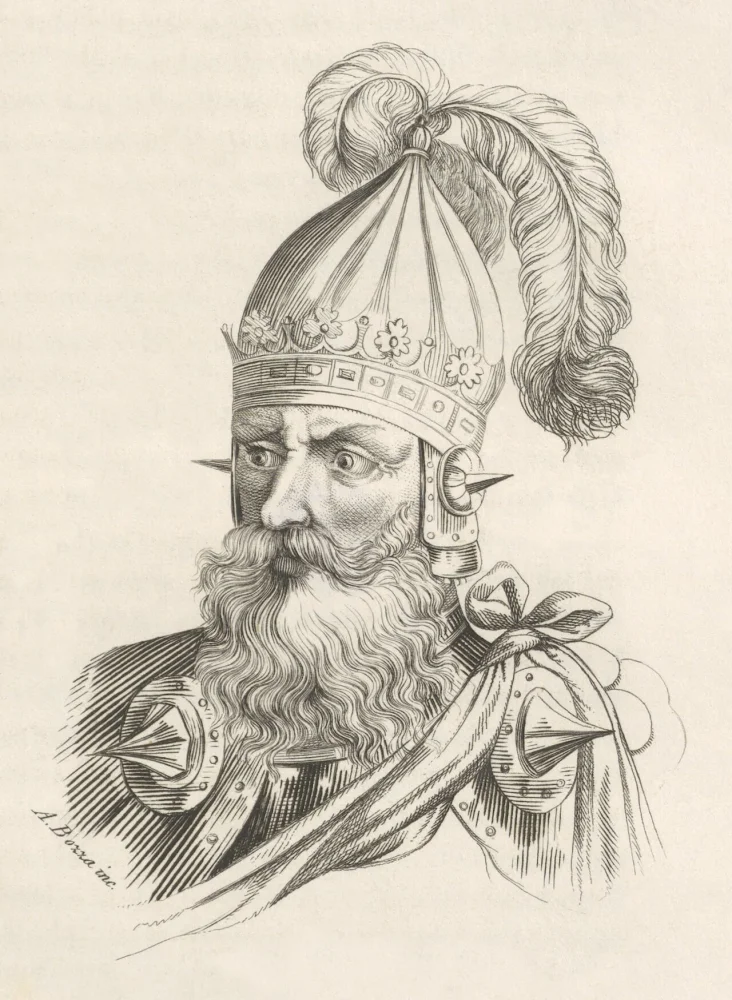
Mindaugas
Mindaugas emerged from the rivalries among Lithuanian rulers to unite much of the country under his authority. By accepting baptism and a royal crown recognized by the papacy, he briefly brought Lithuania into the network of Christian kingdoms of Europe. His rule was marked by pragmatic alliances as well as warfare, and his death plunged the young state into renewed conflict.
Rise to power
Little is known about Mindaugas’s early life, and the surviving sources offer only a partial picture of his rise. By the mid-thirteenth century, he had become the leading ruler among the Lithuanian dukes. He worked to bring neighboring territories under his control and faced opposition from relatives and other regional leaders who resisted his growing authority.
In 1251, Mindaugas accepted baptism in the Latin Christian rite. The conversion helped secure an alliance with the Livonian Order, a branch of the Teutonic Knights, during conflict with his rivals. It also opened a path to recognition from Pope Innocent IV, who supported the creation of a Lithuanian kingdom. In the summer of 1253, Mindaugas was crowned king, the first and only ruler of Lithuania to hold that title.
A kingdom among its neighbors
The crown gave Mindaugas a place in European diplomacy, but his authority remained contested. The agreement with the Livonian Order involved grants of western lands, including parts of Samogitia, where local resistance continued. Mindaugas balanced the Order against neighboring princes and pursued alliances to maintain his power.
His conversion appears to have been closely tied to political strategy, though the sources are not clear about his personal religious convictions. Later accounts accused him of turning back to pagan practice, but historians cannot establish exactly when or how his religious policy changed. This uncertainty reflects the broader challenge of reconstructing his reign from limited and often partisan chronicles.
Murder and memory
In 1263, Mindaugas was killed in a conspiracy led by Daumantas and Treniota, two members of the Lithuanian elite. The attack also claimed the lives of his sons, and the kingdom entered a period of internal struggle. The monarchy did not immediately survive as a stable institution, but the political consolidation achieved under Mindaugas helped lay foundations for the later Grand Duchy of Lithuania.
Modern Lithuania remembers him as a key figure in its early statehood. His coronation on 6 July 1253 is commemorated each year as Statehood Day. The story of his reign is more complex than a straightforward tale of national unification: Mindaugas was a medieval power broker who used diplomacy, religion, and force to build a kingdom amid shifting alliances.