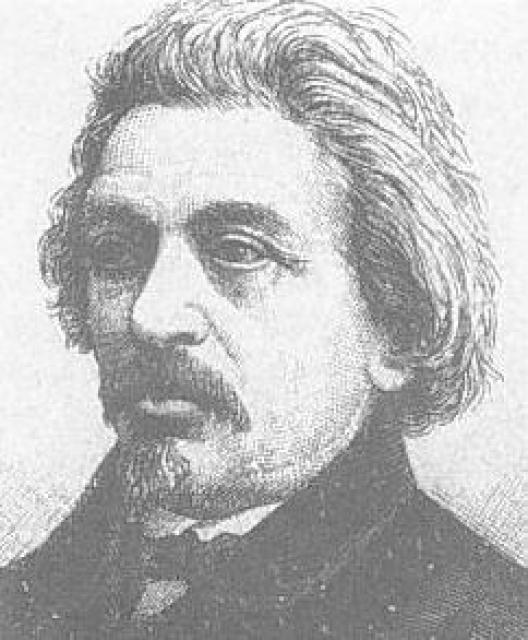
Moses Hess
 France
- Moses Hess: German Socialist, Zionist Pioneer, and Philosopher
- Radical Journalism and Communism
- Influence on Karl Marx
- Pragmatism and Support for Lassalle
- Zionism and Jewish Nationalism
- Return to Jewish Identity
- Legacy and Impact
Moses Hess: German Socialist, Zionist Pioneer, and Philosopher
Early Life and EducationMoses Hess was born in Bonn, Germany, into a Jewish family. He spent his early years with his grandfather in Cologne, who instilled in him a love for Jewish tradition and the Torah. In 1837, he enrolled at the University of Bonn to study philosophy but did not complete his degree.
Radical Journalism and Communism
By 1841, Hess had become a prominent editor for the radical "Rheinische Zeitung" in Cologne. He embraced the concept of "true socialism," a synthesis of German idealism, French utopianism, and the ethics of Ludwig Feuerbach. Hess believed that communism would embody the principles of practical ethics, replacing the exploitative capitalist system with free labor.
Influence on Karl Marx
Hess had a significant influence on Karl Marx, who joined the "Rheinische Zeitung" in 1842. Together, they collaborated on several projects. However, Marx later rejected Hess's brand of utopian socialism, criticizing it vehemently in the "Communist Manifesto" of 1848.
Pragmatism and Support for Lassalle
Despite Marx's critique, Hess remained a committed ethical socialist. He supported Ferdinand Lassalle's theories from 1863 onwards, recognizing the importance of political economy in the pursuit of communism. Gradually, Hess's idealistic views gave way to a more pragmatic approach.
Zionism and Jewish Nationalism
Hess's early writings reflected his belief in Jewish assimilation through emancipation and intermarriage. However, after the Damascus Affair of 1840, his views began to shift. In his 1862 masterpiece, "Rome and Jerusalem," Hess argued that the primary force driving human history was racial conflict, with the secondary force being class conflict.
Hess believed that the Jews were a "world-historical race" alongside the Aryans and that their cooperation in the realms of culture and spirituality had created modern society. He rejected notions of racial superiority and discrimination, advocating for harmonious collaboration among nations and support for social progress through national independence.
Return to Jewish Identity
Hess's experiences with antisemitism led him to embrace a Jewish national identity rooted in the preservation of Jewish selfhood in exile. He saw the establishment of a Jewish state in the ancestral homeland of Eretz-Israel as the ultimate goal of this national identity.
Hess believed that national survival depended on preserving Jewish religion and customs, calling for a revival of the Sanhedrin, the Jewish high court, to adapt religious laws to the needs of a modern Jewish society.
Legacy and Impact
Moses Hess faced criticism for his ideas from both the socialist and Jewish communities. However, his work gained recognition during the rise of the Zionist movement. His writings influenced prominent Zionist leaders such as Ahad Ha'am and Theodor Herzl.
Today, Hess is remembered as a visionary who explored the complex intersections of socialism, Zionism, and Jewish identity. His analysis of Jewish issues in the European context remains insightful and his writings continue to inspire and challenge thinkers to this day.


